Leave a comment

Play Furniture and Pretend Food From Recycled Materials

November 15th was National Recycling Day and I thought it would be fun to share some toy accessories that you can make by recycling materials you have on-hand.

This all started back when Henri had received a Zhu-Zhu Pets toy hamster for Hanukkah one year. It wasn’t long before his “pet” needed to have its own house and so we adapted a shoe box into rooms with a garage.

Of course every home needs furnishings and that’s where these projects came in. According to Henri there was a bedroom, kitchen and living room, so I tailored what I made to that, but you can easily adapt any of these little projects to your rooms of choice.

The first recycled materials to be used were an egg carton and a plastic bendy straw. Cut out sections of the carton to create different types of furniture.

The cups that hold the eggs became armchairs (when the upper rim was kept on 3/4 of the edge) and a table (when flipped upside down and trimmed to have legs).

Two of the flat base of the egg cups were cut out to become vessels for food and water, and finally the divider piece that separates the eggs was cut out to become a lampshade.

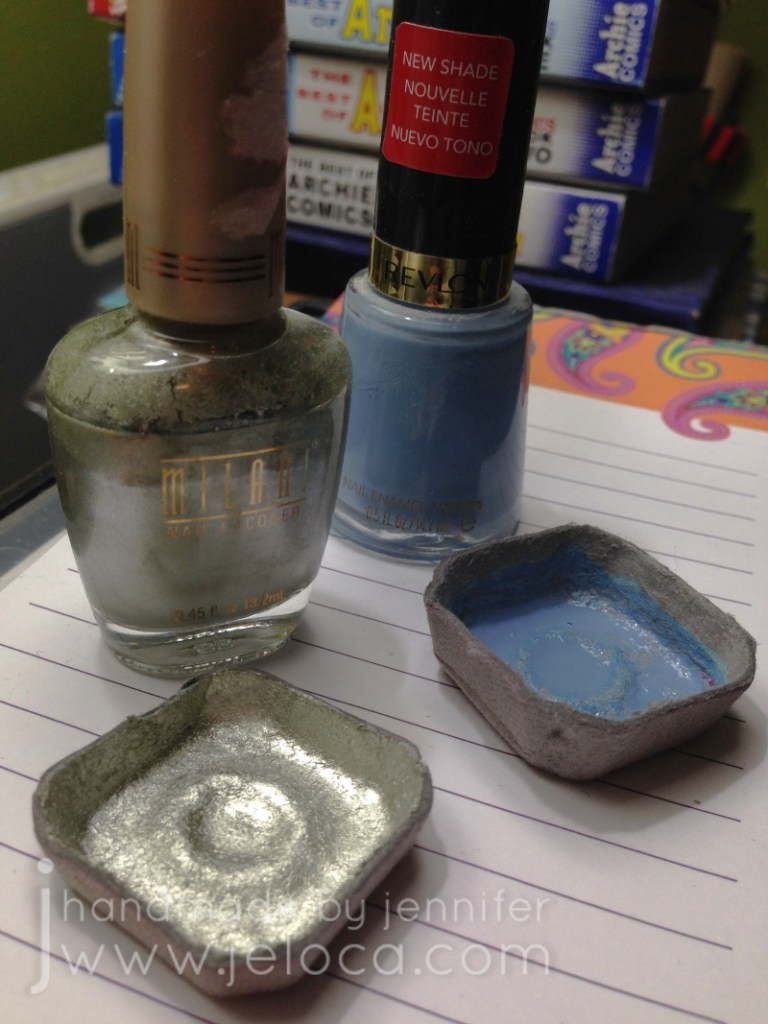
One of the cup bases was painted silver to become a serving plate and the slightly deeper one had the inside painted blue to appear like water. To make the most out of using what I had on hand (pun intended!) I painted them both with nail polish!
The lamp shade was painted Henri’s color of choice with regular acrylic paints and then set aside to dry.
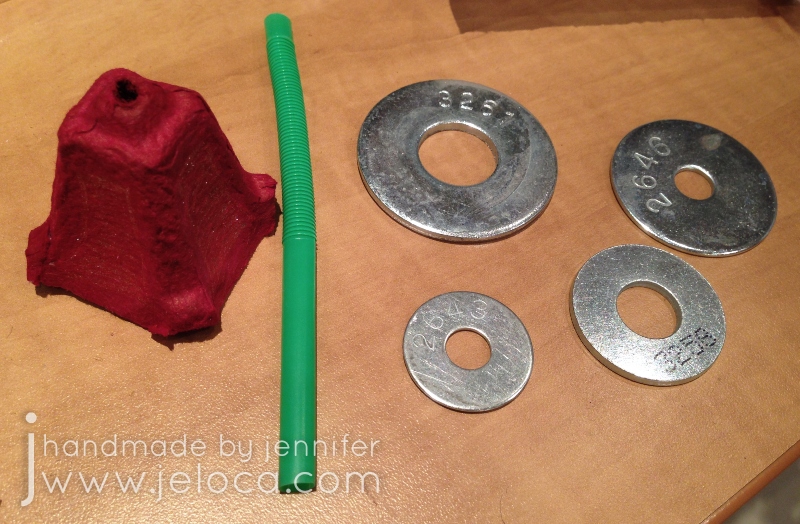
Once dry it was time to assemble the lamp. You need a base that’s sturdy and heavy enough to support the weight of the shade. You could use wood blocks, a little box filled with rice or sand, or anything else heavy enough. I used a few spare washers I found in my toolbox.
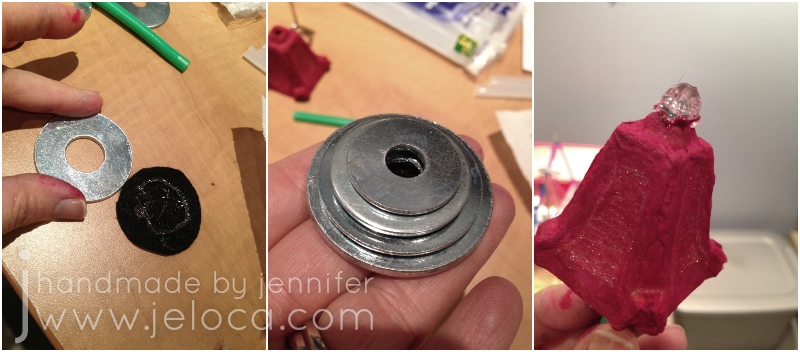
I cut a felt circle for the base and hot-glued the washers on top in descending size order, making sure to keep their holes lined up. I also glued a decorative bead to the top of the lampshade.
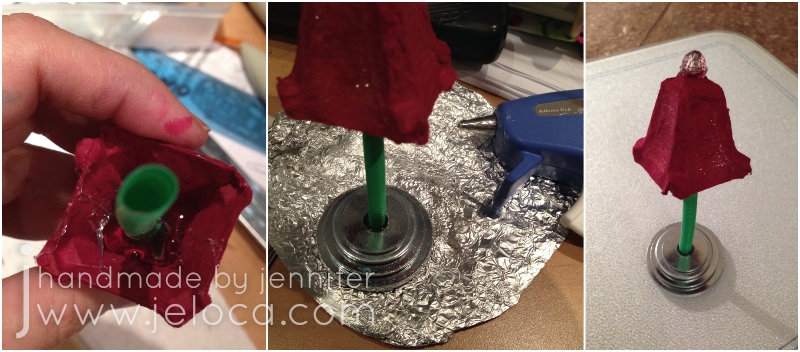
The shade was filled with hot glue to set the straw in place and then more glue was used to attach it inside the tower of washers.

With that, the little hamster’s living room lamp was complete!
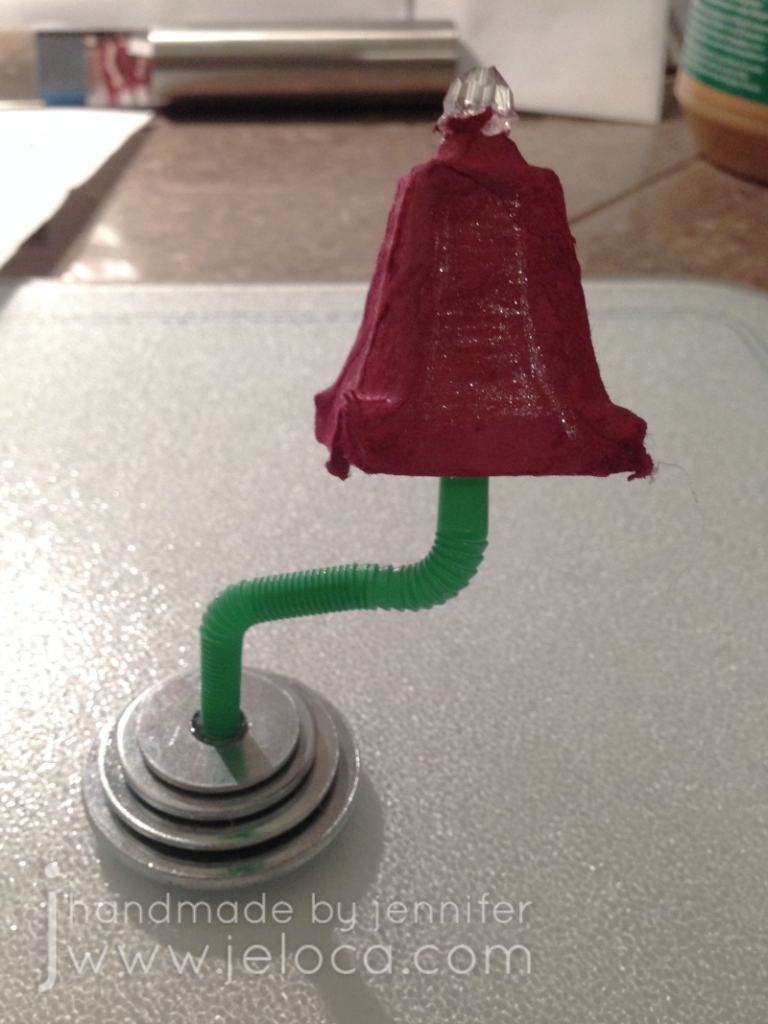
The bendy bit of the straw was a nice touch, allowing the lamp to be angled wherever the little guy needed.

The silver platter received a coat of clear nail polish to seal it and the water bowl was filled with more hot glue to look full.

To make the pretend food for the hamster takes only three supplies – a pool noodle, fabric paint, and scissors.

That’s right – all these little pretend foodstuffs are actually squishies! They’re really easy to make: simply cut pieces of the pool noodle foam into the general shape of the food item then use fabric paint to make them look like their respective foods. A toothpick comes in handy instead of a paintbrush when working at such small sizes. I scaled my foods to the size of the egg carton “plate” and made (clockwise from top right) pepperoni pizza, chocolate chip cookies, donuts, a cheeseburger, and a chocolate cake.

The food storage bin was made from plastic canvas and yarn scraps.

First I made a base large enough to hold all the food. The lid is the same size but less deep, and the faux latch is simply stitched on top. The lid was sewn to the base all along the back edge but I used the same gold yarn as the latch to embroider 2 fake “hinges”.
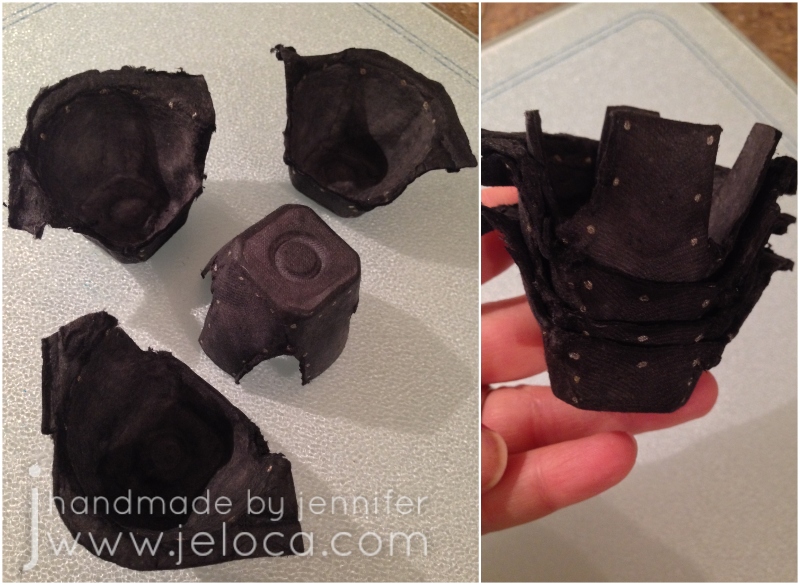
The living room furniture was painted black and copper “studs” were added with a paint pen. One neat thing about using the egg cups is that the furniture will stack which makes putting it away after playtime that much easier.

Finally the hamster’s cardboard box bed was upgraded to one with a full headboard and footboard, and painted with gold glitter paint.

I used scraps of white felt and stuffing remnants to make a mini mattress and pillow, and leftover sock yarn knit up quickly to make a colorful blanket.

One evening of crafting and by morning the hamster had his house completely tricked out. Henri was really excited to set everything in place and added more to the decor by painting a rug in the living room and even drawing a TV on the wall!

Bonus – I wanted to take some current pics to show how well these little accessories held up after 6 years and we thought it would be really cute to include Jakob’s REAL hamster for scale. Here’s Dusty enjoying a little nap…

…and here he is foraging in the snack box looking to see what other treats there might be.

These were such simple, quick and easy DIYs to make and became playtime accessories that were loved and used over and over, AND held up incredibly well over the years. I hope this post gives you some ideas on how you can recycle items from around the house and give them new life with a new use.


Leave a comment

Game of Death Cake

Have you ever seen the movie Game of Death?

This award-winning horror movie came out in 2017 and featured a 90s-style game played by a gang of unassuming teens. Unlike Jumanji the consequences of playing this game are a LOT more gruesome and bloody. It also happened to be produced by one of my dear cousins, and he asked if I could make the cake for their wrap party.

This is the “Game of Death” gameboard as seen in the movie:

And this is my cake replica:

With Halloween just around the corner I thought it was the perfect time to share exactly how I made it!

The first step was to get a few good quality images of the prop that I could use for reference.

I was also asked if I could make a gluten-free option so there’d be something for those with intolerances. I was given a few reference images of the deaths and other props being used and when I saw that one character met an untimely end with a broken baseball bat I knew that would be something I could easily sculpt out of gluten-free puffed rice cereal.

While there were a lot of steps in making this cake it only took 3 days from start to finish. I’m going to break down everything but to avoid this being incredibly photo-heavy I’ve grouped the images of each step together.

The first step for all of my cakes is to sketch out an idea. Knowing I needed to transport the cake I went out and bought the largest cake board that would fit in a cake box I could find locally. That let me know what total dimensions I had to work with. That allowed me to size out my cake pans and figure out what would work best for the game cake. I then scaled a clear, top-down view of the game board to the appropriate size and traced it out so I could have an accurately-sized template.

I tried to do as much in advance as I could, as some of the parts would need time to dry or cool. The next task for day 1 was to make the gameboard’s window pane. I’d been asked to write a congratulatory message to the cast underneath, and while I could have simply written the image on a slab of fondant and set it in place I was determined to see if I could make the “glass” too. While browsing my local bulk store I noticed these clear candy mints and thought they’d be perfect!

I crushed the candies in a plastic bag using a meat mallet and then slowly melted the candy powder in the microwave until they reached a soft, pliable stage. Since I had a scale template I was able to test my cookie-cutters to find the right size and then trim off the excess with a kitchen knife. Once my “glass screen” was ready I set it aside to cool and harden.

Still on day 1 I rolled out some white fondant and made the center skull, all the minis, and the curved bits that line each player spot. I also cut out a base to put under the glass screen so I would have somewhere to write the message. Using a fondant roller and mat was really convenient as the roller has level guides so the pieces were all of equal thickness and the mat has measurements built right in.

I then made a large batch of gluten-free puffed rice treats and sculpted them into the two halves of a baseball bat, ensuring they would fit properly on my cake board. (Another benefit of having a scale template!).

The final thing I did on day 1 (not shown) was to bake the actual cake. I was given free reign on flavor and picked vanilla as it would work best with a special request I’d been asked – could I make the cake bleed when cut. I followed my usual methods and baked a bit of extra batter in a mini cake pan as I wanted to test the bleeding effect. I didn’t want to take a chance on the actual cake just in case it didn’t work so this little tester would be perfect.

Day 2 began with making edible fake blood. The best recipe I’ve found is to mix up chocolate syrup (like for chocolate milk) with clear corn syrup and a bit of red food coloring. Adjust the ratios until you get a consistency you like. In a subsequent cake I made a thicker version that is more realistic but for this cake I deliberately thinned it a touch so it would be able to be runny when cut.

I cut a well into my test cake’s bottom layer and iced it carefully so the “blood” wouldn’t soak into the cake itself. I then added the top layer and iced the whole thing and waited a few hours to be sure no red tint seeped through to the exterior. Then my kids helped me cut it and test if it worked:

It did! I was really excited knowing I could add additional wells into the real cake for an even more horrific effect.

I then painted the baseball bat treats with chocolate candy melts. Using a mug warmer was the perfect way to keep the candy warm long enough for me to get both pieces fully coated.

Then I wrapped each half with white fondant leaving the matching edges broken and torn to simulate where the wood would have splintered when the bat snapped in half. I used my fondant detail cutter to fray the edges further and add more realism, and then painted the fondant to look like wood. I’ve used this technique before and have a full tutorial on how to do it here.

With all the accessories and add-ons ready, day 3 was where it all came together!

I leveled my cake and torted it into 3 layers. These cake levelrs make it so easy to divide a cake into multiple levels evenly! The first layer was placed down on a round cake board and then iced, and the second layer was applied. I used a cupcake filler to cut a well in the center as well as add additional little surprise blood spots around the resulting ring. I was careful to not put them too close together so the cake would still have structural integrity, as I knew there would be a lot of fondant on top and I didn’t want it to collapse.

I also made sure to keep the cake bits from the corer as they’d come in handy in a minute.

I iced the middle layer, being careful to not disturb the cut edges too much while still evenly coating them in icing to provide a barrier between the blood fill and the cake itself. Then I carefully filled each well with the blood mixture leaving about a half-inch of space and then plugged the gaps with the cake pieces I’d saved. Finally, I iced the underside side of the remaining tier so when it was flipped onto the cake, the icing completely covered the plugs. This will prevent any of the blood from potentially bleeding into the upper tier.

Now that the cake was fully stacked I was able to use my scaled template to trim it to shape.

I then set the cake into place on the cake board, using a dollop of icing to “glue” it down. It was iced and then covered with gray fondant to match the game in the movie.

Then I used my template to cut out a slab of white fondant and used one of the fondant detail tools to trace each of the sections of the board, leaving imprints on the fondant that I could use as guides. I used edible food markers to color in each section, blending them with water when necessary to avoid too many streaks.

The topper was set into place and the edge trimmed with a border of white fondant. I “glued” each of the pre-made bits in place with a bit of water and then finally wrote the game’s logo on the front edge. (It went on all sides in the movie but I didn’t trust myself to write it evenly 8 times!)

The last step was to use a bit of watered-down fondant to “glue” the bats into place and then drizzle them with the fake blood mixture. I added in a few bits of fondant “gore” as an added touch. 😉

With that the Game of Death cake was complete! We delivered it to set on the final day and from the feedback I received it was a big hit!

(And it oozed “blood” perfectly when cut!)

This post may contain affiliate links. This means I might make a small commission on purchases made through the links, at no cost to you.


Leave a comment

Ghost Cupcakes DIY

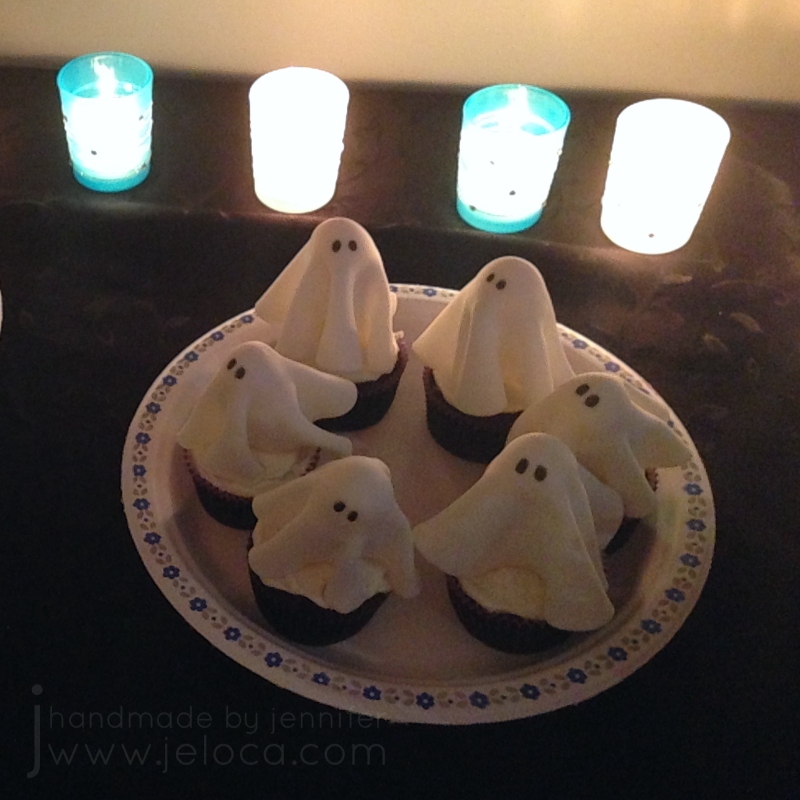
In today’s post I’m going to show you how to make these fast and easy ghost cupcakes, perfect for Hallowe’en!

The sweet treats can be prepped in advance and top homemade cupcakes or you can pick up store-bought cupcakes and throw the whole thing together last-minute.

I’d seen versions of this style topper on various sites around the internet and put mine together using the features I liked from various ones, plus added my own twist. These and these have fondant over marshmallows but I didn’t like the square look it gave the ghosts. These and these achieve a more rounded look by draping fondant over lollipops, but as my cupcakes were for a party for adults I didn’t think the lollipops would end up eaten. After browsing my local bulk shop I came up with the idea of topping the marshmallows with rounded gumdrop candies.

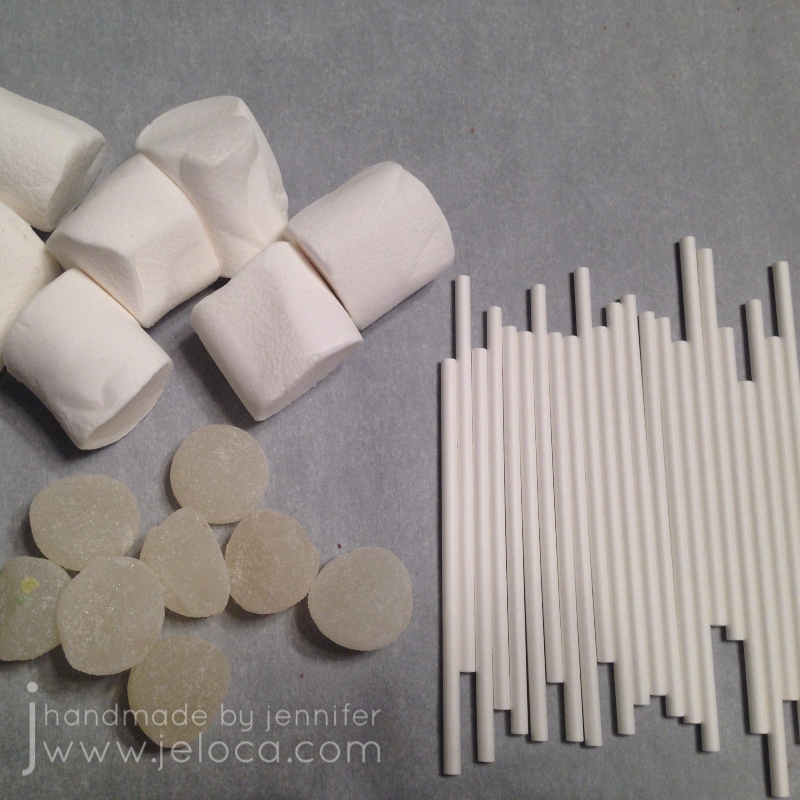
What you will need for the ghosts:

You can place each ghost in a treat bag and hand out as-is or use them to top homemade or store-bought cake or cupcakes.

Step 1: Assemble your marshmallows, gumdrops and sticks to prepare the ghost bases

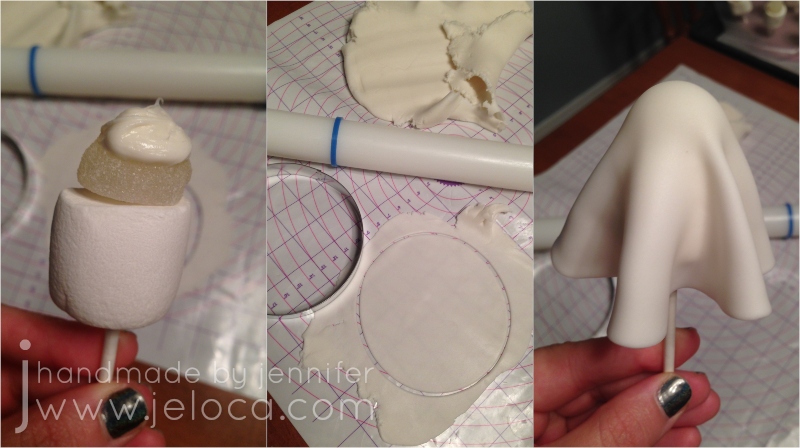
Push the lollipop stick up through a marshmallow and halfway into a gumdrop. You can wet the top of the marshmallow first with a thin smear of icing, clear piping gel or light brush of water to help the marshmallow and gumdrop adhere together, however I found that the tackiness on the stick from being shoved through the marshmallow did not make this necessary.

Repeat until you have as many ghost bases as you need, then set them upright by pressing into foam, flower foam, egg cartons, etc…

Roll out your fondant and cut out a circle with your cutter. I topped each gumdrop with a small dollop of icing so the fondant would stick, but you can also use clear piping gel or water. Apply the fondant over the ghost base, centering the circle over the gumdrop and smooth into place. Use your fingers to crease the excess into ghostly folds. Note: don’t apply too much icing/water/gel or the fondant can thin and tear if it gets too wet.

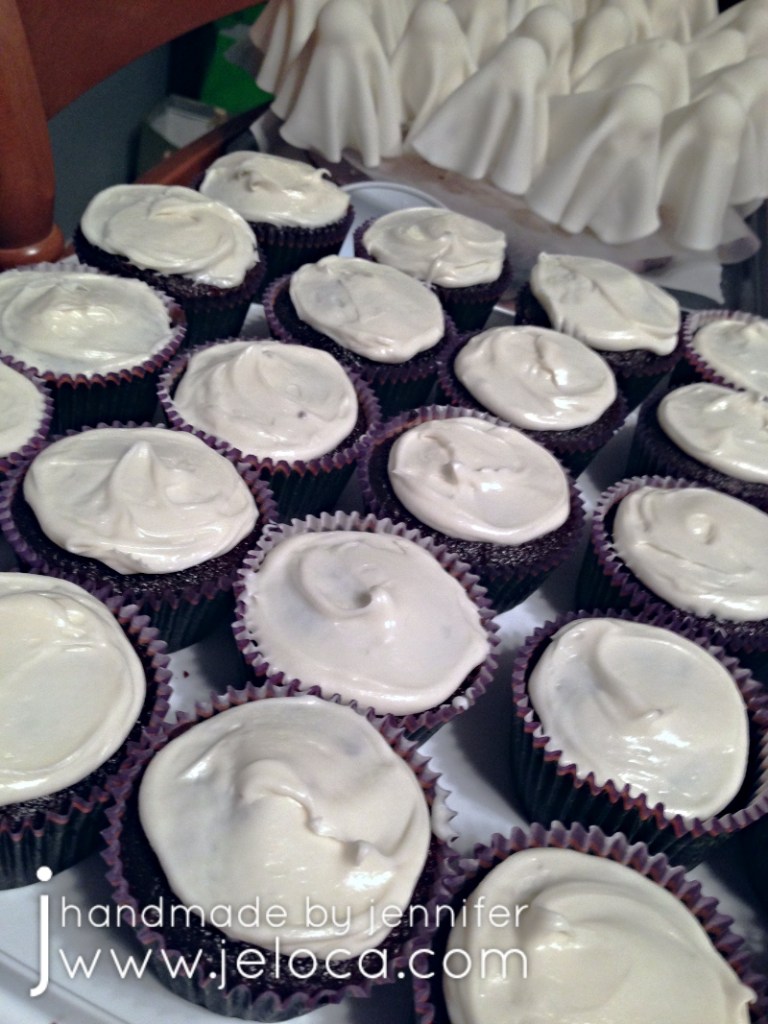
Repeat for each ghost and set them aside in your chosen support so the fondant can set up a bit. If desired prep a cake or cupcakes to be ready for the toppers. I’d baked up some chocolate cupcakes and gave them a thin layer of vanilla icing.

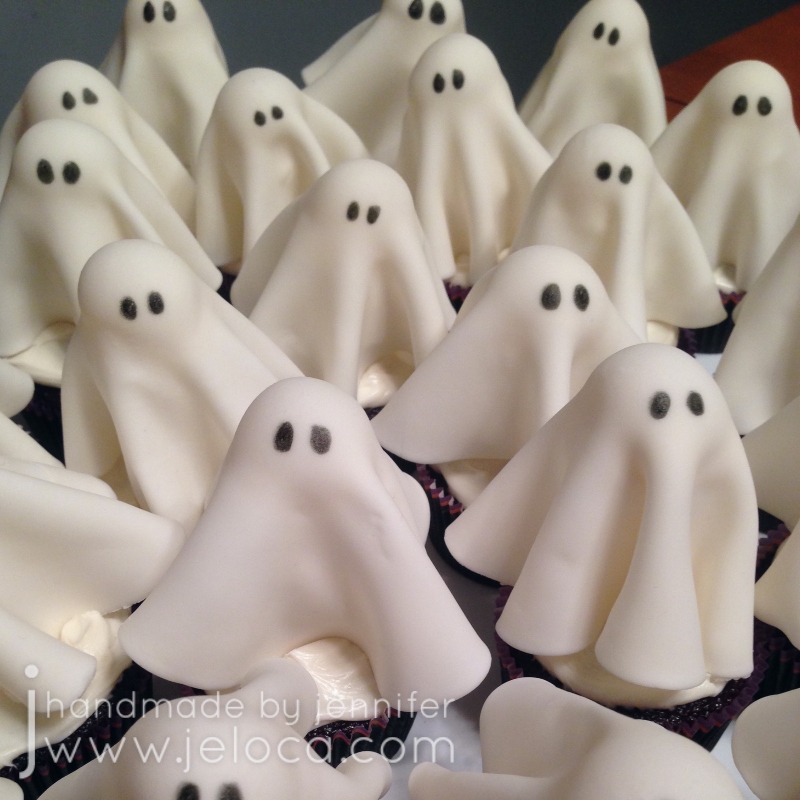
Once the fondant is no longer pliable you can finish off your ghosties by adding black eyes with a black edible marker. You can play around with the eye shape to give them all unique expressions!

Repeat until all your ghosts can see and then set them into your cake/cupcakes (if using). If you are placing them into treat bags to give out as Hallowe’en favors, allow them to air-dry until the fondant sets up.

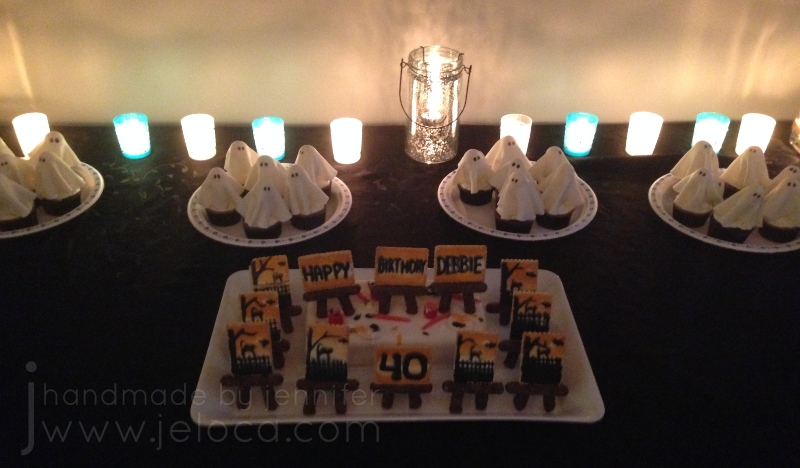
These were served along with the Paint Nite cake and cookies from my last post, and made for a really fun Hallowe’en party treat table!

This post may contain affiliate links. This means I might make a small commission on purchases made through the links, at no cost to you.


1 Comment

Paint Nite Cake and Cookies

A few years ago I made a dessert for my friend Debbie’s surprise Hallowe’en-themed party. I was given the option to make cookies or a cake, so I chose both! This Paint Nite-inspired cake and cookie set is easy to make and looks way harder than it is!

You can start with a store-bought cake, or bake one yourself and prepare it for decorating with a layer of fondant to look like a tablecloth. I used white so the rest would stand out but you could use any color.

To make the easels you will need narrow rectangular cookies. You can bake your own or go the faster route and buy them! I used Cadbury Fingers but any log or stick-shaped cookie will do. You will need candy melts as the “glue” to hold the easel together so just be sure to match the candy melt color to your chosen cookies. Note- you don’t want to use regular chocolate for this as it will soften at room temperature and your easels will fall apart.

First make an A shape with a cookie going horizontally across two others for the easel’s ledge, and then after the candy melts set up use a 4th cookie as the vertical support leg. It’s easy to work this assembly-line style, being sure to leave enough time for the chocolate to set hard. I found that I only had to hold them in place for about a minute before they were able to stand on their own.

Of course any Paint Nite needs something to paint on! You can bake cookies yourself or use any rectangular cookie that has at least one flat side, like Biscoff, butter biscuits or shortbreads.

To make edible “paint” mix icing sugar with small amounts of water until you get a loose icing consistency. Paint Nite projects often have a gradient background with a silhouette design on top, so I used that style for my mini paintings. I chose Fall colors with pumpkin orange and white for a sunset and as this was a Hallowe’en party I added a black cat on a fence silhouette and full moon. This also worked well with the Paint Nite habit of using few colors in beginner paintings.

I painted the cookies much as you would at an actual Paint Nite – first painting the gradient background, then once dry adding the top layer.

The fun part was making each one just slightly different, while still being the same image – exactly how the results at a true Paint Nite would be. Everyone follows the same process and comes out with mostly the same image yet they’re all slightly unique to the individual artists.

I also used a few extra cookies to write a message for the birthday girl on her big day.

Of course, every Paint Nite requires supplies, so we need to add the solo cups-as-water cups, Styrofoam plate “palettes” and big orange brushes.

I made all the accessories out of scraps of fondant. For the solo cups simply layer a thin strip of white on top of the red before cutting out a strip to roll into a cup shape. The brushes are narrow rolls of fondant with the brush end dipped into the icing “paint”. The plates are small discs of white fondant smeared with dollops of leftover paint from painting the cookies. To make the “dirty” paint water I swirled a bit of each paint icing into clear piping gel.

Staging the table was super fun! Unlike a real Paint Nite where I try to be as neat as possible, here I got to be messy! I “glued” the fondant accessories in place with a small dab of water and then added drips and splatters of the paint to really sell the “end of the night of crafting” look.

I was so thrilled with how the final cake came out! It was one of the most fun cakes to make and allows for a ton of personalization. All the components can be homemade or store-bought which means this design can work with all budgets, and you can tailor the paintings to match any theme.

This post may contain affiliate links. This means I might make a small commission on purchases made through the links, at no cost to you.


Leave a comment

Annual Halloween Roundup

It’s October, so that means it’s time for my annual roundup of costume-related patterns and tutorials available here on the blog.

Here’s a step-by-step tutorial on how to make Minecraft Steve & Creeper heads.

Next up (with over 420,000 impressions on Pinterest in the last 60 days alone!) is a similar tutorial, this time for making a Minecraft Enderman head along with a diamond block trick-or-treat box.

Both projects include full charts for game-accurate colors and the exact hex codes for perfect color matching!

If your idea of fantasy is less block-based and more magical, here’s a free knitting pattern for an easy scarf in the Gryffindor house colors.

If training a dragon is more your thing, here’s how to make a viking vest.

If you prefer Pokemon to Night Furies, here’s an easy, last-minute Pikachu costume idea.

If your friends-group themed costume runs more Grease than Greninja, here’s how you can make a super simple Poodle skirt.

If you’re looking to visually upgrade some inexpensive props, here’s a demo on repainting plastic swords.

If you’ve got a last-minute party invite to deal with, here’s a SUPER quick ‘n easy Jughead Jones (from Archie Comics) costume tutorial with free burger dream bubble printable!

If your group costume needs accessories, here’s a free tutorial on making Super Mario Bros Mario, Luigi, Wario and Waluigi hats

If you want to take those Mario Bros costumes one step further, here are instructions on making their respective mustaches

If you REALLY want to go all out, here’s the full costume breakdown with instructions on making an entire Wario costume

Finally, if you’ve got enough knitting time on your hands, you can knit my Baby’s First Superhero Costume pattern as-is with cute designs for boys and girls, or convert the chart and the colors to create your superhero of choice.

Find more tips and tutorials on my How-To page!


2 Comments

Iced Angry Birds Cake

Over the years I’ve made a couple Angry Birds-themed cakes. Two of them were for members of the same family, and even though they were made years apart I wanted them to each feel unique. For this first one I used minimal fondant and worked with an iced base.

Cakes like this are pretty easy to do, and while I don’t have full step-by-step pics I’ll outline the process.

The bottom layer was baked and prepared exactly as in my post on how to bake a cake and prepare it for decorating. I then decorated the sides with Smarties (M&Ms for my American readers) and set it aside.

The top layer also started as a 9″x13″ cake which was cut into the shape needed. As for most of my shaped cakes I started with a paper template scaled to the proper size on my computer.

The template serves two purposes. First I used it to trace out fondant pieces for the eyes, brows and beak. As I didn’t want to cut into the template I used a straight pin (that I keep for food use only) to pierce the shapes’ outlines into rolled fondant. The resulted dotted line is easy to cut out with a knife or fondant cutter and the individual pieces can be attached to each other with a bit of water or fondant glue. The eyebrows and pupils were cut from pre-tinted black fondant, the beak was cut from white fondant tinted yellow with icing gels, and the eyes were cut from white fondant later outlined with a black food marker. Before putting away my fondant supplies I also cut out the birthday boy’s name from red-tinted fondant with alphabet-shaped cookie cutters.

Then I used the same paper template on top of the cooled cake and cut around it to cut the cake itself to the proper shape. (You can do these steps in the reverse order but sometimes cake will stick to the underside of the paper and that can discolor your fondant. Another option is to trace the cake shape onto wax paper or parchment paper which won’t stick as easily)

The second cake was then iced with red and white icing to match Red’s proportions and finally the fondant topper was added.

The fondant pieces give the cake a polished look while requiring minimal shaping or sculpting ability, making this a great way for beginners to try out fondant for the first time.

This post may contain affiliate links. This means I might make a small commission on purchases made through the links, at no cost to you.


Leave a comment

DIY Twisted Sister Album Replica

Today I’m going to share the steps I took to create a prop replica of this Twisted Sister record album for a Becket stage show a few years ago:

We had done a skit routine to the song “We’re Not Gonna Take It” which was released 38 years ago today, on April 27th 1984. In addition to the skit requirements of tossing the record album around, in general props are often flung out of the way during quick set changes, and we didn’t want to take a chance on damaging an actual record, even if we’d owned one. Therefore I decided to make this stage-safe replica that I could easily re-make in case of damage or loss.

The basis of the record is a piece of stiff cardboard cut to size. Standard record albums are 7″, 10″ and 12″. Unfortunately the best piece of cardboard I had was only 11″ wide but since no one would be able to tell from the audience so I cut it into a square to use. The key was cardboard that would be thick enough to not bend or warp during the multiple rehearsals and performances. If your cardboard is too thin you can layer a few sheets together with glue.

To replicate the “You Can’t Stop Rock ‘n’ Roll” album, my next step was to paint the entire surface with black acrylic paint. I will be demonstrating the steps for this specific album but the same principles can be followed to recreate any required prop for theater or costume use. You can even copy your favorite albums for wall decor!

Many of my projects involve using templates and this one is no different! Once I’d chosen my cardboard I printed a copy of the record album to the appropriate scale.

Then I used the graphite trick of scribbling along the back of my image in order to transfer the design. These days I use carbon paper as I find it faster and easier, but pencils work well too.

With the back of the image covered in graphite (or with carbon paper underneath), I placed it into the correct spot and traced over all the lines. A stylus works great for this but you can just as easily use a pencil or ballpoint pen.

It’s hard to see the transferred image. I did play with the contrast to try and show it but it’s pretty faint.

Using the original album cover art for reference, I colored in the image with metallic markers and added highlights with a Derwent Drawing white pencil.

I used the same transfer method to add the album title…

…though this time I pushed a bit harder into the cardboard to give my marker ink borders. This can help contain a bit of the ink flow, if your markers are very runny. If you don’t have markers in the proper colors you can paint your album cover instead.

I had a close-enough color in my metallic markers so I used that for the band name and smaller lettering.

That’s it!

The final touch was a few coats of sealant for protection and then the album cover replica was complete!

This was a super easy and fast DIY that looks incredibly effective on stage, and because it was only cardboard and markers I didn’t have to add to our prop budget nor worry if it took some abuse and I had to remake it. That said, it was surprisingly sturdy and held up great through every rehearsal and all performances.

You can easily use the same steps to recreate any album for your own prop needs.

This post may contain affiliate links. This means I might make a small commission on purchases made through the links, at no cost to you.


Leave a comment

World Creativity and Innovation Day

It’s World Creativity and Innovation Day so today’s post is a round-up of previous posts that I feel incorporated some outside-of-the-box thinking!

Ever need to transfer live stitches to waste yarn but can’t find your tapestry needle? No problem! Here’s an easy way to “knit” the live stitches over so you can keep working on your project.

If you find standard provisional cast-ons too difficult, here’s a super easy way to get your knitting started. No extra tools required!

Here’s a neat trick for making thin vines/ropes for use in decorating your cakes or cupcakes. They’re flexible, stretchable, and edible!

Here’s a hands-free way to hold your coloring books open!

Not getting the look you want with colored pencils in your adult coloring books? Here’s a great way to add more tooth to the paper.

Are your fondant balls/pearls coming out all different sizes? Here’s a super easy hack to get identical ones, every time!

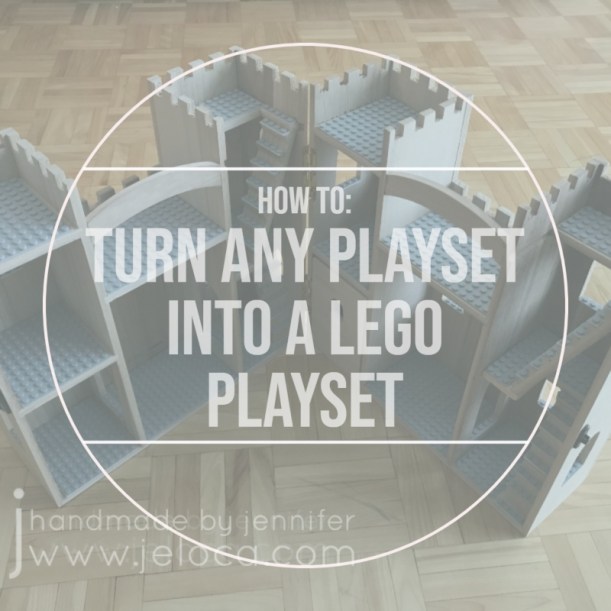
Here’s a simple way to give a plain toy new life and make it work with your LEGO pieces.

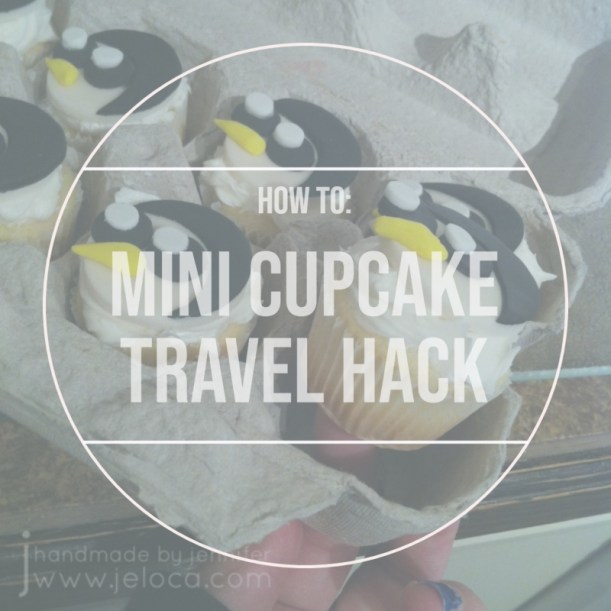
Finally, for when you want to provide homemade, individual snacks, here’s a free & easy way to transport mini cupcakes by repurposing something you’ve probably already got on hand.


7 Comments

How To: DIY Super Mario Bros Banner

For my last post of Mario Month 2022, I’m going to show you how to make these DIY Super Mario Bros-themed banners:

I used them as stage runners for a Mario-themed skit, but they can also be hung as banners to dress up the decor at a Mario-themed party, photoshoot or event.

In case it’s been a while since you’ve seen what a Super Mario Brothers game looks like, this is the setting I was attempting to recreate on stage:

I’ve already made a warp pipe set piece, but to really give the stage a “Mario-world” look I decided to make banners/runners in the style of the iconic bricks, blocks and ground texture.

If you look at the screenshot it’s clear there are 3 distinct patterns – the bricks, the “?” blocks, and the ground sections. Before I can scale and print my templates I needed to know what dimension I could work with.

I used the same roll of recycled paper as for the warp pipe, and it is 36″ wide so the easiest thing to do was to cut the roll in half lengthwise, and base my measurements around that.

On my computer I cropped out one repeat section of each of the 3 patterns and scaled them evenly to be 18″ high.

I printed the templates and taped the sections of paper together to have exactly the pieces I needed. Then I cut my strips to the proper length. The floating banner (the one Mario jumps on/under) was cut to fit 6 blocks of my template wide to best fit the width of our band’s drum riser. For the ground-level banner, I wanted to fill as much as possible of my stage width, so I divided my total stage width (about 30′) by the width of the ground template, and made sure I cut my length appropriately to fit in the maximum number of repeats that would fit my stage.

This paper rolls up nicely which makes storage of both the materials in progress as well as the final banners a breeze!

As for the warp pipe, the whole project was done with inexpensive materials, including the acrylic paint. I started with the floating segment and marked off the width of each segment, then painted the brick sections brown.

I had just barely enough room to set it aside to dry so I could move on to the stage runner.

The stage runner was given a brown base coat along the entire length.

Due to space constraints, I set up my workstation to allow me to keep moving the runner to the right, while working from the left.

Luckily by the time I ran out of room to extend the far end, it was dry enough to roll up on itself.

The ground template would be getting a lot of use as I had to trace it over and over along the entire length of the runner, so I protected it with my favorite cheap lamination method – packing tape.

Then I set about tracing it over and over and over…

Carbon paper is fantastic for this as it provides erasable marks that are dark enough to be seen but light enough to be painted over. I used a ruler to be sure my lines would be straight, and a pen, stylus or chopstick/skewer would all work equally well for the tracing.

Once all the tracing was done it was time to paint the details. This required black and white paint, along with some extra brown to fix any mistakes.

I didn’t want any color bleeding, so first I worked my way through painting the white sections…

…rolling the work up as soon as it was dry enough to move forward…

…and then once the white was complete I moved it to the other side to start over, now painting the black ones.

It’s a long process, but very relaxing and great for podcast/audiobook listening!

With the ground painted and set aside, I returned to the floating banner and added a lighter brown base to the “?” block sections.

Just as for the ground, I traced my templates and then worked in sections to paint them.

First I did all the black and the bit of white highlight on the bricks…

…and then I went back in and did the remaining brown on the “?” blocks.

I love the finished result! It’s so easy and doesn’t take too long but has such a high visual impact for the stage or as party decor.

You can see how accurate the result turns out when you use a good, scaled template.

Once all the painting was done I gave the banners a few days to air dry to be sure there was no moisture left in the recycled paper, and then I set about laminating them.

If you’re only making a banner for a party or to stage a photoshoot, this next step is optional.

Just as for the warp pipe, these banners would be used in a stage show with multiple performances and incredibly quick set changes, and it would be a waste of my time and effort making them if they ripped during rehearsal or mid-performance.

Starting with a 1-2′ strip of tape, I lay it on one of the straight edges, overlapping halfway. Then I lifted the edge of the banner and folded the free half of the tape over, pressing well. This protected the edge of the paper from any moisture getting in.

Repeat the process on all edges. For a long banner like the ground one, you can do this in sections as you go.

Then, using more packing tape, work horizontally across your piece to laminate it. Overlap your strips slightly, again to make sure no gaps are left where moisture could get in. Once done, trim up your edges with a craft knife.

I chose to also laminate the back of my banners. While this does use up extra tape and is not visible to the audience, it provides an extra layer of durability and moisture protection. Also, as we were using velcro tape to quickly hang and remove the banners during each performance, I didn’t want to take a chance on being able to pull the tape off from the paper and damaging it.

The finished banner is now durable and reliable for frequent rough handling.

I then repeated the same process on the ground-level banner.

And with that, they are complete. The banners roll up easily for storage and transport, and applied perfectly to our stage pieces with heavy duty velcro tape. We had incredibly quick, rough set changes where the stage hands slapped them into place and then ripped them off while running off stage during the blackouts, and they held up perfectly!

Here’s how they looked on stage. The original plan was to have the drum riser get the floating banner and hang the ground runner off the front of the stage, but in dress rehearsals we realized that it would be too low to be seen by anyone in the audience except the very front, so we raised it up to run the length of the full band riser instead.

It was a really cute, fun skit/dance number, and definitely an audience favorite. I was so pleased that my stage runners, warp pipe, and all the costume pieces were an important part of that, and have held up to this day (4 years later).

All of this year’s Mario Month posts are from that skit, and next year’s will include instructions on how to make Princess Peach’s wand, Toad’s hat, and the Piranha Pete costume.

Other Mario-themed posts you might like:

This post may contain affiliate links. This means I might make a small commission on purchases made through the links, at no cost to you.


8 Comments

How To: DIY Super Mario Bros Wario Costume

All month long I’ve been sharing Super Mario Bros-themed DIYs for my official 2022 Mario Month, and today’s post pulls all the Wario costume pieces together with some final touches to round out an easy DIY Wario costume.

For a refresher, here’s the yellow-and-purple guy himself:

And here’s how my cosplay turned out:

You will need:

To make the Wario hat you can follow my DIY instructions here.

My easy DIY instructions for the Wario mustache are posted here.

Wario’s gloves are a pair of simple white gloves with a rolled cuff and large blue “W”s on the back of each hand. I used an inexpensive pair of winter “one-size-fits-all” stretchy gloves and the same dark blue felt as for the W on his hat.

Because my costume was needed for several performances with quick (and rough) costume changes, I sewed the “W”s into place with matching thread. If you’re not worried about durability you can choose to use hot glue instead. In both cases, however, I would attach the letter while wearing the glove, as if you sewed it while laying flat it would not stretch properly once worn. (The glue or stitches would hinder the gloves’ stretch and the letters would appear wonky and/or possibly detach).

Repeat the process for the other hand.

Note: I’m right-handed, so it was easy to sew the left glove while wearing it, but not as easy for the right. At first I tried to compensate by wearing the left glove backwards on my right hand, so I could continue to sew with my dominant hand.

Unfortunately the results look terrible. Therefore I really recommend wearing the glove on the appropriate hand and sewing with your non-dominant one if necessary. If you go slow and take small stitches while awkward…it’s not impossible, and the results look much better.

Wario’s clothes consist of a solid-color yellow tshirt and purple pants with suspenders. I’ve linked suitable options for all three items above, though for my costume I was lucky and found the shirt and pants at my local thrift store. I didn’t think Amazon would have purple suspenders so I made my own. I happened to have some purple fabric at home so used that, though the color match wasn’t the best.

To make the suspenders yourself, put on the pants and and take the following measurements:

Length: measure the length in inches from the waistband in front, up and over the shoulder, and down the back to the waistband in back. Add 3-4″ to this measurement.

Width: the desired width of your suspenders in inches, doubled, plus 1″.

You will first create a tube by folding your fabric in half lengthwise, wrong-sides out, and then sewing a line about 1/2″ in from the open edge.

Once your tube is secure, carefully flip it inside-out. A knitting needle/skewer/chopstick is handy for this! Arrange the fabric so the seam is in the center and iron or finger-press the edges down to keep the strip flat.

The 3-4″ inches extra length added were for use in attaching the suspenders. If your pants have belt loops, first pass one raw edge through the opening of the claw hook, fold the edge in about 1/2″ and then sew down securely. My hook rotates but if yours is stationary be sure to have the side of the tube with the seam at the back.

Once the hook is attached, fold the other raw edge over as well and then sew it to the pants at the rear waistband, again being sure to have the seam on the inside. If you prefer a less permanent option, you can use claw hooks on the other end of the tube as well, and attach on both sides using the belt loops.

If your pants don’t have belt loops you will need to sew all 4 edges into place.

Wario’s pants are actually overalls with big white buttons but it’s easier to create suspenders and then fake the button look on top. If you prefer to make overall straps then instead of attaching claw hooks you will need to make a buttonhole and then sew 2 buttons onto your pants. I was worried buttons might undo during my dance number so I went for the more secure option of suspenders.

To fake the button look, cut two circles out of white felt and stitch (or hot glue) them into place above where the suspenders attach.

With that, your Wario costume is done! I wore this during a performance with fast quick-changes, so having my next costume underneath was the perfect way to add some padding and give Wario his more rounded physique.

Other Mario-themed posts you might like:

This post may contain affiliate links. This means I might make a small commission on purchases made through the links, at no cost to you.