2 Comments

Making a Pitfall: The Lost Expedition cake, day 02

Most of the cakes I make are a 2-4 day process.  The final 2 days are always baking 2 nights before the party (so Friday for a Sunday cake) and then decorating on the day before the party (Saturday for a Sunday cake).  I add a few more days prior if I need to make fondant decorations or anything that requires drying time.  This Pitfall cake, for as detailed as it looks, took 3 days.

Day 1: Thursday

When I got home from work I prepared the base stand to get it to look like a brick wall with a cave by covering it with fondant and scribing a brick pattern to match one from the game.

Day 2: Friday

pitfall lost expedition night 1 07

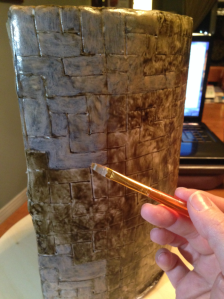
In the morning before leaving for work I gave the stand a quick wash of color.  I needed to fill in the grout lines and give it time to dry before I got home.  In a small cup I mixed together 1 drop of black Americolor food gel, 1 drop of brown gel, and 6 ml of water.  I used a food-only paintbrush to apply the wash to the fondant, not aiming for any sort of pattern, and allowing the color to drip and run a bit before smoothing it around.  I let it set for a minute or two then dabbed at it with a paper towel to remove areas of excess, and then used the same brush with only water to remove even more color.  The goal was not to paint or finish the brickwork but to allow the dark color to seep into the etched lines and provide some aging. 

At this point it looks like a dark, muddy mess.

When I got home from work I rushed to bake the 2 cakes I’d need.  I knew I’d have plenty of time for them to cool before I planned to ice and decorate on Saturday, but I often use the oven for storing fondant bits overnight and didn’t want there to be any residual heat left inside it.

pitfall the lost expedition cake day02 01
pitfall the lost expedition cake day02 02

When the cakes were cooled some I wrapped them in saran wrap to set aside for the night.

Then I prepared the table for getting down to some fondant painting.  These are the supplies I prepared: in the lid of my color box are a smaller box of Americolor icing colors and a bottle of Wilton White-White, then the contents of the case itself is my collection of Wilton icing gels and some regular, grocery-store-type food coloring.  I brought down some cotton balls thinking I might use them for blotting, but testing on a scrap of fondant revealed it stuck terribly to the wet sweet, and I quickly got rid of them.  I’ve got a measuring cup of water for rinsing my brushes, a small cup of water and syringe for adding clean water to my colors if I need to thin them any (the syringe gives you way more precision when working with tiny amounts of color than dropping by spoonful or pouring), and a small cup of the leftover dark wash from the morning that I’d kept moist in a tupperware for the day.  I’ve got a few sizes of food-safe paintbrushes and some paper towels for blotting, and finally at the bottom is my standard palette, left over from an old pack of hors d’oeuvres.

pitfall the lost expedition cake day02 03

That’s the palette I use most often, and it works great with larger quantities of color, like when tinting icing sugar/water for the fondant toppers I make.  However when using tiny bits and blending a lot of shades I find it’s not as practical, and I eventually switched over to an artist’s style palette with small dabs of the gel colors on it, and a small styrofoam tray for blending.  The colors bead up on the tray so I don’t lose any to absorption.
pitfall the lost expedition cake day02 04

I prepared the stand by putting it on my lazy susan., These things are SO useful with decorating and crafting! I’ve actually got three – one wood, one glass, and one plastic, depending on my project needs.  I stuck a tub of icing in there to help weigh it down.  The stand is pretty heavy, especially with the fondant, but that was a precaution.

The first thing I did was to mix up a color that approximated the bricks I was trying to copy.  In the game they look like this:

pitfall lost expedition bricks

Now that I had the general shape scribed in and the darker grout lines, I needed to lighten the bricks to a faded, creamy, beige-ish color.  I began to mix up a color, testing on the paper towel until I had something that looked right.  You can see at the bottom of this next pic where I’d tried out a color that was too pale, and I had to darken it up a bit.  In the end I used some Wilton White-White as a base, then some brown and black Wilton gel colors, a touch of Wilton lemon yellow, and some of the morning’s dark wash water to thin it out.

pitfall the lost expedition cake day02 05

I painted small dabs of the resulting mix onto each brick individually, blending and smoothing until I got rid of the brush strokes and had something that looked like an old brick wall.

For the first time ever I took a short video of my process.  If you find it helpful and want more video tutorials, please let me know in the comments.  🙂

pitfall the lost expedition cake day02 07

After the back was done I moved on to the front.  The small amount of mixed color that you saw in the video was enough to paint the entire back and front.

pitfall the lost expedition cake day02 06

The next step was to add some greenery.  I knew I’d have a lot of grass and vines and leaves in the cake, but wanted to add more depth to the bricks so I used more of the dark wash and deepened it up with Wilton gels (leaf green I think).

pitfall the lost expedition cake day02 08

I used a messy brush to pounce the color in areas where moss would grow, mostly around the bottom of the back piece and around the top and sides of the front.  This is a great reason to keep those brushes that get all messed up, so you don’t ruin good ones!

pitfall the lost expedition cake day02 09

As I added the moss I made sure to keep the brush from being too wet – the effect was supposed to be subtle – and I also periodically touched my brush in different areas of the mix where I hadn’t fully blended, sometimes picking up straight gel from the edge of the palette.  This gave me varying shades of green and a more natural look.

pitfall the lost expedition cake day02 10

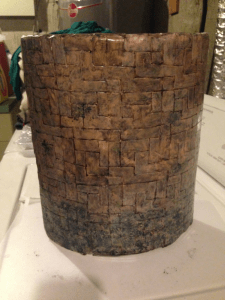
Finally I used some White-White and Americolor black and a touch of brown to get a nice varying gray shade for the rock cave.  Again I resisted the urge to overmix the color, so I could get depth to the wall.  Sometimes I touched in a bit more white, which lightened the grays, and then I’d go back in with a more liquid black, getting into the cracks.

pitfall the lost expedition cake day02 11

Here’s the finished support, set aside for the night.  The front (above) and the back (below).
pitfall the lost expedition cake day02 12
This post may contain affiliate links. This means I might make a small commission on purchases made through the links, at no cost to you.


1 Comment

Making a Pitfall: The Lost Expedition cake, day 01

For Henri’s 7th birthday party he wants a Pitfall cake.  As in Pitfall: The Lost Expedition.  As in the old PS2 game all 4 of us at home play, and love.

This gave me a bit of a challenge.  The most iconic visuals from Pitfall are, well, the pits.  And Pitfall Harry swinging on vines.  Pits would be easy enough to make, but vine-swinging?  Hmm.  This required a think.

My first thought was to make a framework that would go over the cake with vines and a little fondant Harry hanging down, but while I poked around at work, looking at unused frame displays, a new idea struck.

I found a 2-level display that got my creative juices flowing.  In order to plan properly (and avoid scale mishaps like in the Diego & Dora cake) I took iPhone pics from a few angles and then printed them out really pale, so I could sketch over them and have a rough idea of what I wanted to do.

It’s difficult to photograph something clear but you can get a rough idea of my process here:

pitfall lost expedition paper demo collageFirst I sketched my plan onto paper.  You can sort of see in the first image that I have a brick wall with a balcony-like upper tier.  The blue overhang is supposed to be a waterfall that flows down onto the cake below, and it’s not easy to see unless you click, but there’s a healing spring/fountain hidden behind the waterfall.  Once happy with the sketch I needed to see if it would work, conceivably, and so I used some scrap paper and made a quick mock-up of where the actual cakes would go.  There’s one layer of cake on the top tier, the ‘waterfall’ hanging down, and then a layer of cake the same height as the bottom tier, butted right up against it.
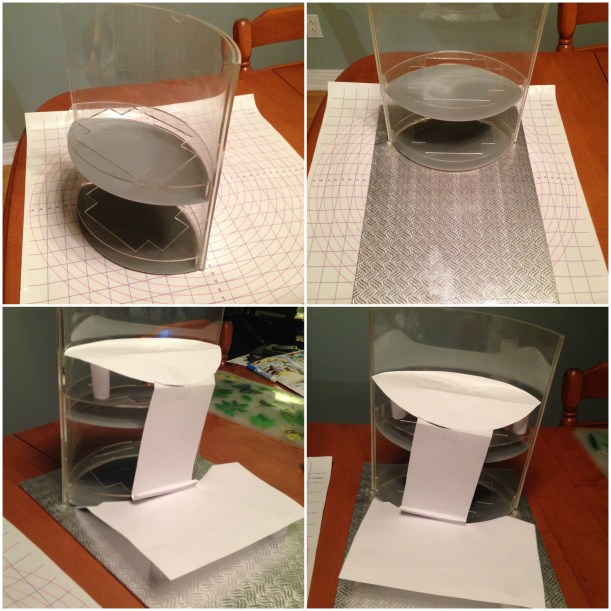
Okay… maybe there’s something here.

This was Thursday, and his party would be on the upcoming Sunday afternoon, so I knew I had to get started right away.  After work I stopped at a bulk candy store for supplies like green sprinkles and extra fondant.  I also picked up 2 cake boards.  I usually use trays for my cakes but I didn’t know how well the stand would fit and I didn’t want to be limited by side edges.  I bought 2 so I could ‘glue’ them together with icing, as I didn’t think 1 board would be strong enough to support the heavy cake.

pitfall lost expedition home paper demo collage

Here’s the same paper mock-up at home, on the actual cake boards so I could test for fit.  What I was hoping for, and am happy about, is that the board is long enough for me to extend the lower cake section beyond the paper template.  I plan to have crocodiles in the water but hope for room to put a pit as well, and I think this will give me enough.pitfall lost expedition night 1 01

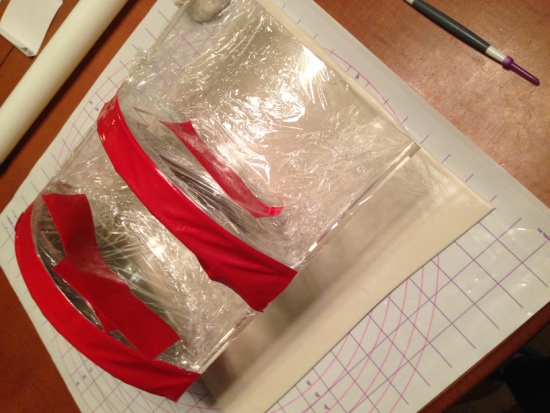
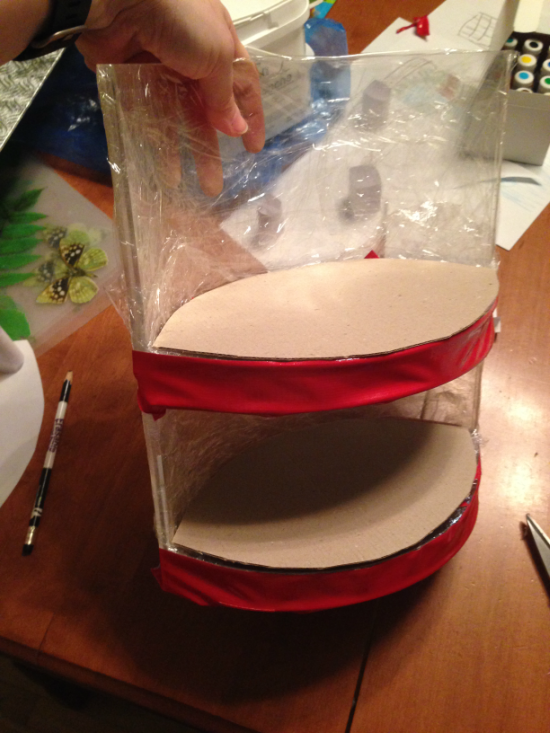
Next I cleaned the display stand and wrapped it in saran wrap, and used duct tape to block off the two open edges.  I also cut 2 cardboard ovals to fit over the tiers, as they have large cut outs where the products are meant to sit.  The top one will be used as a cake board, and the lower one will merely be covered in icing.

pitfall lost expedition night 1 02

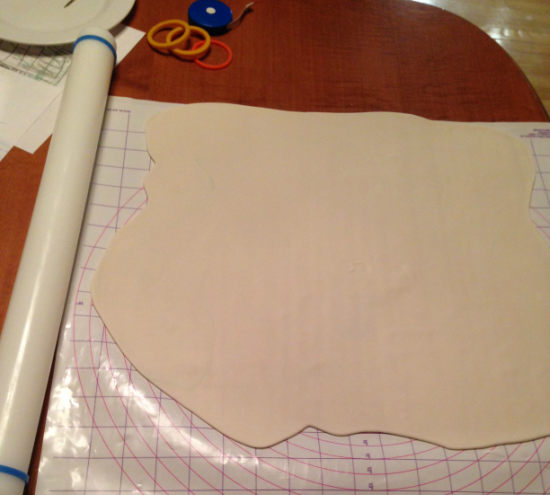
Next I tinted some white fondant to a beige-ish shade and rolled out enough to cover the back of the display…

pitfall lost expedition night 1 03

…and then trimmed it to size.  At this point I realized that even dampened, the fondant did not want to stick to the saran, and I removed all the coverings.  D’oh.  I make the mistakes, so you don’t have to.

Water-dampened fondant DID want to stick to the clean plastic stand just fine, luckily, and I covered the back with the large sheet, smoothing it down well against the back and around the edges, blending it out with my fingers.  I did the same for the larger areas of the front as well, and then carefully wrapped one thick-ish piece around the open edge of the upper tier, smoothing it into place above and below while being VERY careful to not tear through the open front.pitfall lost expedition night 1 04

Once the fondant was secure I used a scoring tool to scribe a brick pattern into the fondant.  I had to be careful to not pierce the open-fronted balcony edge, but for the rest it was all flush against the thick plastic, and I could press pretty hard if I needed.

For the back and the upper tier I did a rough approximation of a brick pattern found in the game, as seen in the background here:

pitfall bricks

I did the back first, then copied the dimensions over onto the front.  For the lower tier, I wanted it to look more like a cave than a brick wall, so I wet the fondant and pressed on little pieces with my fingers, smoothing and adding more until I had something that resembled a natural rocky wall.

pitfall lost expedition night 1 05

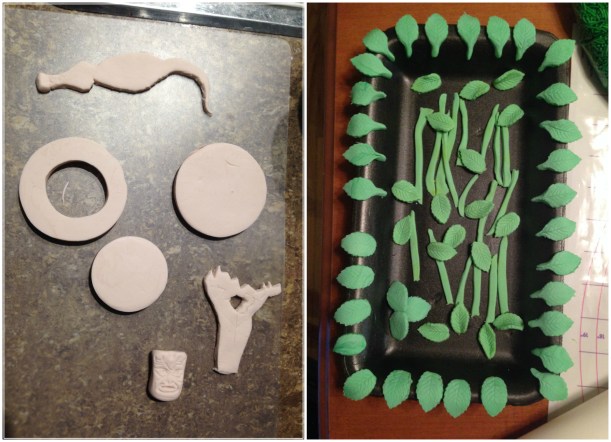
I also used the same beige fondant to cut out shapes to let harden.  On the left are a sleeping croc for in the water, round pieces and a tiki head for the healing spring, and a croc’s open mouth with poor Harry struggling to break free.  (Or, what I HOPE will look like that eventually).  I tinted my remaining beige into a few shades of green and used a leaf-press cutter to punch out 2 sizes of leaves, which I set over the edge of a Styrofoam food tray (saved from buying vegetables) to dry.  I also cut a few strands of tall grass but I’m not sure if I’ll end up using them.pitfall lost expedition night 1 06

At this point it was about 1am and I set everything aside to dry by the dehumidifier and went to bed, knowing the next few nights would probably be pretty late ones to get everything done in time.


1 Comment

linden’s left front – done

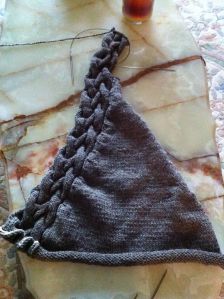
Last night I finished the left front of my Linden jacket.  I remember reading on Ravelry that people said to not continue the cables in the collar shaping, so when I got to that part I was careful to pay attention, looking to see why so many made mention of the collar directions being difficult or to avoid the cable crossings within the shaping, etc.

End result?  I have no idea why so many people had problems with it.  The directions are all there, nothing is omitted or unsaid, if only you know how to read it properly.
Here’s how it works, and hopefully this will help others who haven’t knit this yet but wanted to, and maybe were nervous they wouldn’t “get it”.

After the majority of the front is complete, the st st portion of the front is decreased away  then bound off completely, and the cable is worked on alone until it is long enough to reach up around the back of your neck.  There are short rows worked 4 times to make the collar curve nicely over your shoulder and around your neck.

I don’t want to write out the actual directions here, because it’s part of pattern copyright.  But I think I can be vague enough to not infringe, while still being helpful.

The cables are on a 16-row repeat, with the cable crossings themselves on rows 7 and 15.

The collar shaping instructs you to work 5 rows of short row shaping, then 7 rows in est pattern, and then to repeat these 12 rows 3 more times.  Only the first 4 of the collar shaping rows are partial (short) rows, the 5th row (a ws row) has you working back across the complete row.  The pattern also has you only start the collar shaping once you’ve done a cable cross row, either row 7  or 15, depending on the size you are knitting.

For my size, I started the collar shaping after working a row 7 cable row.

I think what’s throwing people off is that they are looking at the 12 rows you work 4 times, and are thinking it doesn’t work out within the cable crosses.  What’s being overlooked is that you’re not working 12 COMPLETE rows in the cable.  You can ignore the first 4, and only count the 5th row, because that’s the only one that is actually worked across the whole row.

Therefore:

Collar Shaping Row 1 – WS – doesn’t count with cable rows

Collar Shaping Row 2 – RS – doesn’t count with cable rows

Collar Shaping Row 3 – WS – doesn’t count with cable rows

Collar Shaping Row 4 – RS – doesn’t count with cable rows

Collar Shaping Row 5 – WS – counts as cable row 8 (or 16, but I’m working with my size here.  You can adjust the row numbers for where you ended before “Shape Collar”).

Work 7 Rows in Est Patt:

Row 1 – RS – counts as cable row 9

Row 2 – WS – counts as cable row 10

Row 3 – RS – counts as cable row 11

Row 4 – WS – counts as cable row 12

Row 5 – RS – counts as cable row 13

Row 6 – WS – counts as cable row 14

Row 7 – RS – counts as cable row 15 – cable crossing row

And that’s the first repeat.  Then you do it 3 more times.

How this works out is that you have some short row shaping (the first 4 partial rows), then 7 full rows of stockinette stitch, then a cable crossing row, 4 times total.

It’s actually really smart how the short-row shaping was worked into the cables without actually affecting them at all, and hopefully this will help anyone having trouble figuring it out.

My mother-in-law called this weekend to say that we’d be celebrating Thanksgiving next Monday at my sister-in-law’s place, and wouldn’t it be nice if I were to surprise B with her long-awaited  pillows?  Hmmm.  Subtle.  So unfortunately I’m going to have to put Linden on partial hold while I work on the pillows.  It’s frustrating because I’m seeing it progress so fast, but I think I’ve figured out a way to work on both, by bringing Linden as my “take-along-knitting” for the appointment I’ve got later this week, but keeping the pillows (and their accompanying “designing”) as my night-time knitting.


4 Comments

no tapestry needle? no problem!

notapestryndlpin

http://www.youtube.com/watch?v=oYuydpcXbc4

The above is a video I made quite a while ago.  Some of you will recognize the project in my hands – it’s Kate Gilbert’s Papa Bunny that I had made to send to a friend’s daughter in 2008.

This video shows what to do when a pattern asks for a common technique – but you don’t have the right equipment with you.  The last row of the directions said to “thread the live sts onto the working yarn with a tapestry needle and pull tight to gather”.  The only problem was that I didn’t have a tapestry needle with me.  I didn’t like the idea of pulling the stitches open with my fingers so I could get the yarn through easily, as it would distort them.  I came up with this idea instead.  It might be familiar to some of you, or it might be new to you.  Either way, it helped me and I hope it helps you too!  If you’d prefer a photo tutorial (vs the video above) let me know in the comments and I’ll make it happen. 🙂


4 Comments

How to Magic-Loop (video)

I was discussing the Magic-Loop technique with my cousin Amy the other day, and I realized that it is a technique I use quite a lot.  In fact, with the exception of 2(!) projects I can think of in my years of knitting, I have always used a longer needle than called for.  Only twice (my stalled “Perfect Knitting Bag” and the Spiral/Pinwheel Baby Blanket) did I use a needle smaller than the circumference of the knitting so I could knit around uninterrupted.

That being said, I know some people are mystified by the whole “Magic-Loop” idea.  I taught myself by following a photo-based tutorial online, but without needles in hand, even photos can be hard to figure out.

I put together a little video to show how I work Magic-Loop.  It’s not the best as I filmed it myself while knitting and talking, but at least the house was quiet and I think there is enough light to see what I’m doing.  I hate my voice in videos, but there’s nothing I can do about that!


If you have any questions, please ask!


5 Comments

a contest!

Dianne is having a contest over on her blog, and is looking for your favorite tips or techniques.  Here’s one of mine!

One of my favorite knitting tips that makes my knitting life easier is how to calculate how much yarn you’ll need for a long-tail cast-on. How many times have you ended up with a tail that is much too long, or run out right towards the end? Here’s an easy way to know how much yarn you need:
Let’s say you need to cast on 100 sts. Cast on 10 sts then unravel your cast on and see how much yarn it took. Multiply that length by 10 (10 x 10 = 100) and that will show what length yarn you need. Add a few inches for weaving in (or a longer length for seaming, if necessary), and that’s it!

(Obviously you need to multiply the 10-st-co length by whatever number it will take to give you the number of sts YOU need to cast on).

(If you decide to enter, please leave in the comments that I referred you. Thanks!)


3 Comments

just a typical saturday night

Any major knitterly repairs had to wait until tonight, since we had a birthday party this afternoon. One of my best friends’ son turns 2 this week, and our little family was invited to his party. I’m not going to post photos of them since I forgot to ask permission, but I am going to post a different photo (hi Debbie!) to my friend Debbie who is one of the very few non-knitters who reads my blog.

Jakob’s friend Taylor was at the party too, since we’ve known her father since high school, and her mom for the last few years. Taylor is exactly one day older than Jakob.
Hey baby…come here often?
After supper tonight I decided to brave the Superman repairs. I took photos and will break down what I did, step-by-step. It turns out that while I’ve councelled others to do this same repair, I don’t think I’ve actually done it myself before. It was much easier than I’d thought!
First I took a circular needle and wove it through the stitches, making sure to pick up the left bar of every stitch, and verifying that I had the correct number of stitches on the needle. You can also pick up the right bar, it doesn’t matter as long as you consistently pick up the same side of each stitch.
Next, I grabbed a dpn and “picked up” stitches 2 rows below the one on the needles. I only picked up 6 sts at a time so the fabric wouldn’t pull too tightly. Once I had the first 6 sts on the needle, I CUT one stitch on the middle row…the one in between the two rows on needles. I used a spare needle to unpick the yarn from those 6 sts, then took another needle and picked up the next 6 sts, unpicked the middle row, etc… (Yes, I left the scissors in the photo on purpose. Looks ominous, huh? LOL).

Once I’d done that all the way around the row I had the two parts of the leg separate. I was then able to add another 12 rows (1.5″) in length to the foot part of the leg.
With the knitting done, I “tidied” up the two parts by arranging them on 2 dpns each, making sure that I had the front and back aligned properly (wouldn’t want to sew the foot on crooked!). I left a really long tail for grafting, then cut the yarn.
Finally, I Kitchenered (grafted) the foot part to the leg. You can kinda see here how much length was added. I’m breastfeeding (and don’t drink anyways) so I had a cup of Earl Gray as my fortification instead of the typical glass of wine. 😉 I was about to do the second leg when Yannick suggested that I wait until after Jakob wakes up tomorrow so that I can try it on him first and be sure that I didn’t add too much…or need to add more.
So there you have it. One leg lengthened by an inch and a half, with my first not-too-sucky graft. One more leg to go.
You can use this type of repair for any knitting that’s too short and you want to add length, OR you can use it for knitting that is too long.  Follow the same steps to separate the work into two pieces and then unravel the side that goes in the opposite direction of your knitting for the required length, plus one row.  If using my costume leg as an example, I wouldn’t be able to unravel the top piece without picking out each stitch one by one, as I’d be unravelling in the same direction as I’d knit and it would be very time consuming.  I would unravel down the lower (leg) piece as that would be going opposite the knitting and would frog easily.

So if I had a leg that was 10 rows too long, I would separate the work onto two sets of needles and then unravel until I’d removed 11 rows.  The grafting row will account for the difference, “putting back” one row as it joins the two halves together.


4 Comments

my own provisional or invisible cast on alternative

Sometimes a pattern will call for an invisible cast on. An invisible cast on is when you cast on with your yarn and a waste yarn (usually a smooth yarn like cotton in a contrasting color). The way you twist the yarns as you cast on will result in giving you the “backs” of the stitches to pick up later. This means that if you cast on 40 sts, you will have 40 sts ready with your working yarn to knit up right away, and then later when you unpick the waste yarn you will have 40 more sts waiting for you to slip on a needle and begin knitting in the other direction.

This can also be called a “provisional” cast on, and the directions can call for you to crochet a long chain and knit your first row into the back “bumps” of the chain. When you use this method the crocheted chain holds your first row “live” and you can “unzip” the crochet chain later and put the freed stitches back on the needle to knit in the other direction.

I’ve had to use this many times-
– my favorite toe-up sock pattern has you start with an invisible cast on, knit the toe section, then put the other half of the cast on sts on two more needles so you can start knitting the foot in the round.
a gift scarf I knit once had you start with an invisible cast on, knit half of the funky cable pattern, bind off, then put the other half of the cast on sts on the needle so you could repeat the scarf for the other side, ensuring that both halves of the scarf were the same and knit in the same direction (instead of casting on at one end, knitting to the other end, then binding off).
the Samantha baby sweater dress I had knit for my friend’s daughter also has you cast on with an invisible cast on, work a picot edging, then later release the other half of the live cast on sts to hem them up by folding along a turning row and then sewing the hem in place.

It’s that last one that led to my latest ah-ha! unvention. I had decided early on that I was too lazy to sew the bottom hem up later, when I could easily knit it in as I went. Instead of waiting until the piece was done, undoing the waste yarn, threading the long tail on a needle and sewing down each loop of live stitch, I would instead work the hem as directed, but once I’d worked to a point even with the length of the hem (for example 8 hem rows, turning row, 8 body rows) I would release the waste yarn sts to another needle and knit them together with the next body row. This works much as one would do a 3-needle bind off, except you don’t bind off. You just knit a stitch from each needle together.

That worked perfectly, except for one thing: I hate picking out the waste yarn from when you do a typical cast on of this type. Because the only thing done in the waste yarn was to cast on there is only that bottom edge of a contrast, and it is not always easy to find the stitches of your first actual row. I always feel like I’m going to lose a stitch, especially the end ones.

So I came up with an easier idea. In my case I’m going to show you how to use it to knit in a hem, but you can skip the hem part and just use the technique to have your stitches ready to knit your ribbing or hem later if you’re not sure what you want to do yet, or to knit in the other direction (like a scarf or shawl).


I still cast on with waste yarn, only this time I knit a row or so. Enough to give you a row of knit stitches that you can see easily.


Then switch to your pattern yarn and work as you like until the point where you want to knit in the hem. (In this example, I think I’d knit 5 rows, purled a row as a turning row, then knit 5 more rows).

Many times I have been in the middle of a project when I notice an error that can’t be corrected by dropping down just a few stitches. In these cases, instead of just ripping back I sometimes like to insert the needle into the knitting first, then rip. This way I can’t rip too far, and all the sts end up sitting there on the needle for me. This works the same way.

Insert a second (slightly smaller) needle into one half of each of the sts in the first row of your pattern yarn. Make sure you have done this for all the sts (if your row has 32 sts make sure you pick up half each of 32 sts).

Cut the waste yarn in a few random spots in the first row. Make sure to not cut the pattern yarn!


This shows the cut end starting to be unpicked from the knitting.


Use a needle or the points of your scissors to help you pick out the first row of waste yarn.


This leaves the pattern yarn sitting there on your needle, all the stitches looking pretty and ready to knit! This gives you the same result as the traditional invisible cast on, without the fiddly cast on itself and the trial-and-error I always experience when picking out the waste yarn.

And that’s all there is to it! Now the cast on row is ready to do whatever you want. Again, in my case I have done it after some extra hem rows because I will be turning the hem and knitting it in, but you could easily have done this just at the beginning of your regular knitting pattern and then the stitches would be ready to knit your ribbings, lengthen your garment, knit in the other direction, graft something, or do whatever you like!

I’m going to continue the directions for how to knit in the hem for those of you who would like to try this.


Then, to knit in the hem as I did, all you need to do is fold it up and knit a stitch from each needle together. Once that’s done, you just keep knitting your pattern as usual.


This shows the front of the hemmed piece after the hem was knit in and I’d knit about 5 more rows. The turned edge is nice and flat because of the turning row (you can also use a picot edge or anything you like). The bottom is thicker and doubled with a nice, sturdy hem that will not unravel, and the two sides are open so you can insert an elastic if you like. If not then the sides will close when you seam the piece, or you can just seam them shut later.


This shows the back. You can see the stockinette section at the bottom which is the folded hem, and then the reverse stockinette section which is the back of the right-side stockinette part. It’s neat and simple!

This method can be used in any instance where an invisible or provisional cast on is required.

I really got this idea because I have no problem picking up one side of each stitch when ripping back, and that helps me often. I thought, “wouldn’t that be easier than picking out a cast on row and trying to find the sts?” For me, this was much easier, I didn’t need directions on how to cast on, nor a crochet hook. Quick, simple and painless. Hope this helps someone like it did me!


11 Comments

how to make a poodle skirt

On Tuesday afternoon, my sister Laura called me up out of the blue and asked if I could make her a poodle skirt. No rush or anything…she only needed it by Thursday morning. Being the wonderful, amazing, loving, insane sister I am, I agreed.

The total cost for this project is minimal, about $8 CAD plus the cost of your fabric. I was lucky and happened to be at my cousin Robyn’s place Tuesday night, and she had a huge bolt of pink fabric and I bought some off of her (to be paid for as soon as she tells me how much she wants for it). Your costs may vary depending on the fabric you buy, but the other supplies were cheap. If you already have them at home, it will be even cheaper.

All sewing was done by hand, and the total time for this project was 3 hours.

MATERIALS

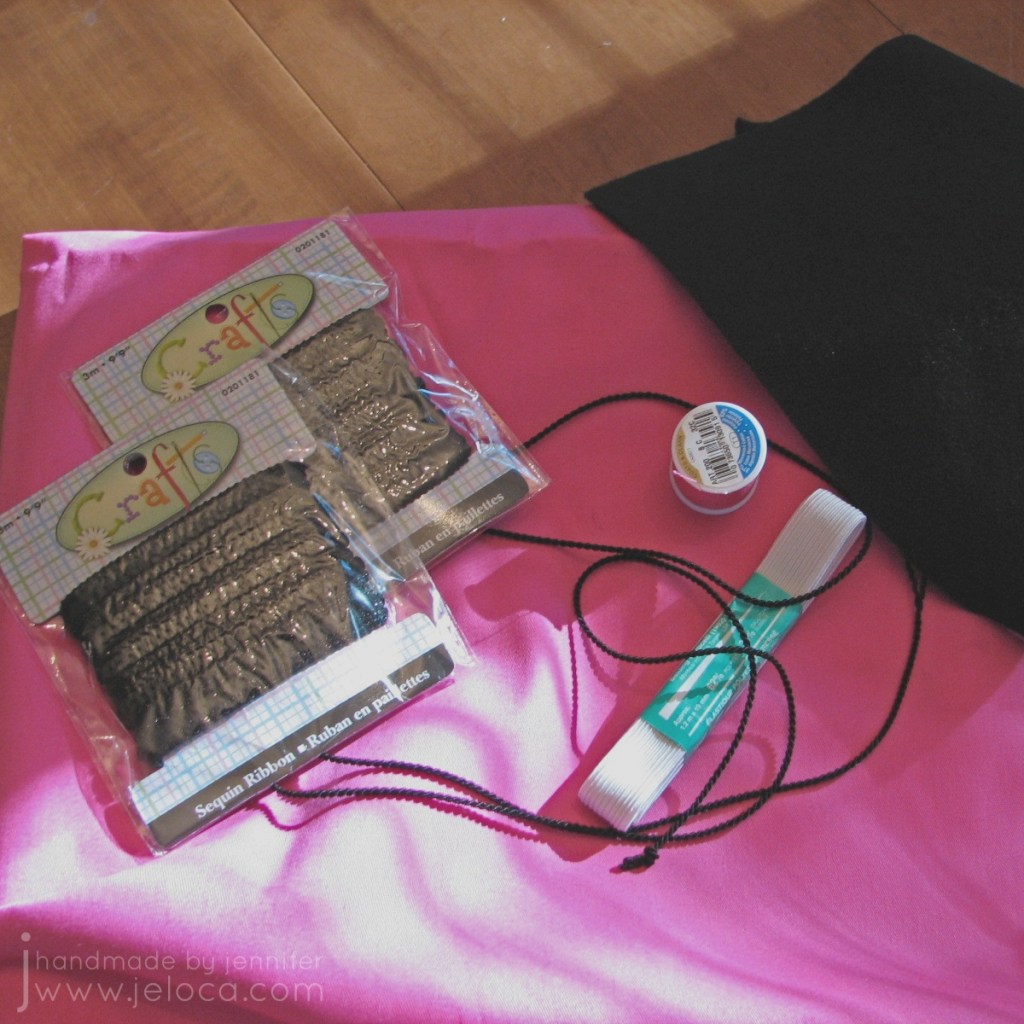
1. Fabric. I like the pink poodle skirts with a black poodle, but you can choose whatever color pleases you. White with blue is a nice combination too. The width of your fabric (not the length) will be the diameter of your skirt. Cost- variable. (Here’s something similar on Amazon).

2. Felt. The felt is for the poodle. Choose a piece that is at least as big as the size of the poodle you would like to make. Cost for 1 piece of felt- $0.25 at Dollarama, or get bulk packs

3. Trim. This is for the edging. You can choose whatever kind of ribbon you want, but the wider it is, the easier it will be to apply (it will be used to hide the cut edges of the fabric). The one I chose is slightly elastic, with sequins. It was perfect. You need to buy enough to outline the outside edge of the skirt. To figure out how much ribbon you need, do this formula: measure the diameter of your skirt. Mine was 56″ wide. Multiply this number by pi, or 3.14. I get 175.84″. Convert this amount (inches) into meters or yards, depending on how your ribbon is sold, plus a little extra for insurance. I needed something like 5.6 yards, and my ribbon is sold in packs of 3 yards each, so I bought 2 packs. Cost for 2 packs of trim- $2.00 at Dollarama, or get by the spool

4. Elastic. This is for the waist band. I didn’t buy the really skinny kinds of elastic because I didn’t want the waist band to flip. Buy whatever kind you like, long enough to go around the intended wearer’s waist. Cost for the elastic- $1.99 at BouClair, or get by the spool

5. Thread. For sewing the waist band. I didn’t buy black because I already had, but I didn’t have a pink to match the fabric. Cost for the thread- $1.78 at BouClair or buy an assortment

6. Cord. This is for the leash. You can find all sorts of funky cords at fabric and notions stores. I chose a cord that is actually two thinner cords twisted around each other like a rope. Cost for the cord- $0.39 at BouClair or get a collection of colors

7. Beads (not shown). I chose to make a beaded collar for the poodle, because I have a stash of beads already. Cost for the beads- n/a but if you don’t have any on hand, you can get started with a beading kit

DIRECTIONS

Step 1- Get a Square: Lay out the fabric and find a square. To do this, fold one corner of the fabric up against the other side in a triangle. Cut away any excess fabric, and you will be left with a perfect square (as perfect as the fabric is, anyways).

Step 2- Find the Center: Fold the square back into a triangle, and in half (as a triangle) again. Find the corner where all the folds have in common. With your scissors, make a very small snip off the end of this corner. When you open up your square again there will be a hole in the center of it. This will help you make your circles centered.

Step 3- Trace your Circles: Using 2 pencils and some string, make a homemade compass to trace your circles on the fabric. There are plenty of tutorials on how to do this (here’s one) but long story short is to tie the string to the ends of both pencils, put one on the center hole, and, keeping the string taut, use the other to draw a big circle on your fabric. You want the length of the string to be the length of the radius for your skirt.

For example, my fabric square was 56″ across, so my skirt could have a radius of a maximum of 28″. You can check the length by swinging the pencil around and making sure it doesn’t go off the fabric anywhere. If it does, shorten the string a bit. Once your length is good, draw your outside edge circle. It helps to have someone help you by holding the center pencil in place while you draw.

Repeat this process for the waist band circle. The intended wearer has a 27″ waist (color me jealous) so I calculated what the diameter would be of a circle that was 28″ around (28/3.14=8.917). I added an inch because I wanted the waist band to have a gather. If I would have had wider fabric, I would have added more than an inch so it would hang in nice folds. Anyways, once I knew that my diameter was roughly 9″, I shortened the string to 4.5″ (the radius, or half of the diameter) and drew another circle in the center. At this stage my fabric looked like this:

Step 4- Cut it Out: Using your scissors, cut out both circles. You will be left with a doughnut of fabric.

Step 5- Sew on Trim: I used black sewing thread, and used a simple running stitch to attach the trim around the outside edge of the skirt. This worked great because I didn’t have to hem the edge. All I did was, working on an inch or so at a time, was line up the ribbon over the edge of the fabric with the ribbon centered over the edge. By centering it, even if the edge flipped up a little, no one would see the jagged cut edge of the pink fabric. Don’t worry if your edge is uneven, causing your ribbon to not make a perfect circle around the edge. No one will ever know. Mine wasn’t even at all, and you really can’t tell.

Step 6- The Waist Band: I cut and sewed my elastic into a 28″ circle. I folded the edge of the inner circle over it and sewed it down with the pink thread. I made perpendicular cuts into the fabric at 2″ intervals to give me some slack in turning the fabric back to sew it over the elastic. It gets tight at the end, but simply gather the fabric away from where you are sewing and it will work fine. Once the band is sewn in, adjust the gathers so they are even around the skirt.

Step 7- Poodle: Find a poodle shape that you like, and adjust it to the correct size on the computer. Print the poodle and cut it out. Use a contrasting color (I used an orange colored pencil) and trace the poodle onto your felt. Cut out the poodle from the felt. Find a nice area of the skirt to place the poodle. I used the black thread and a running stitch again to sew down the poodle. I didn’t pin or baste it down first, but you can if you are afraid it will move. I made sure to tuck the end of the cord under the neck first for where I wanted the leash to attach. This hides the end under the poodle.


Step 8- The Leash: There is no set pattern for how to place your leash. You can make it as curvy or as straight as you like. I laid out the cord in a pattern I found pleasing. I used tiny stitches to catch the cord at various spots to hold it in place.

Step 9-The Collar: The collar can be as fanciful as you like. There can be no collar. If you have glitter pens, you can use them for both the collar and the leash, if you like. I had spare beads so I made a beaded collar the width of the poodle’s neck, and sewed that in place.

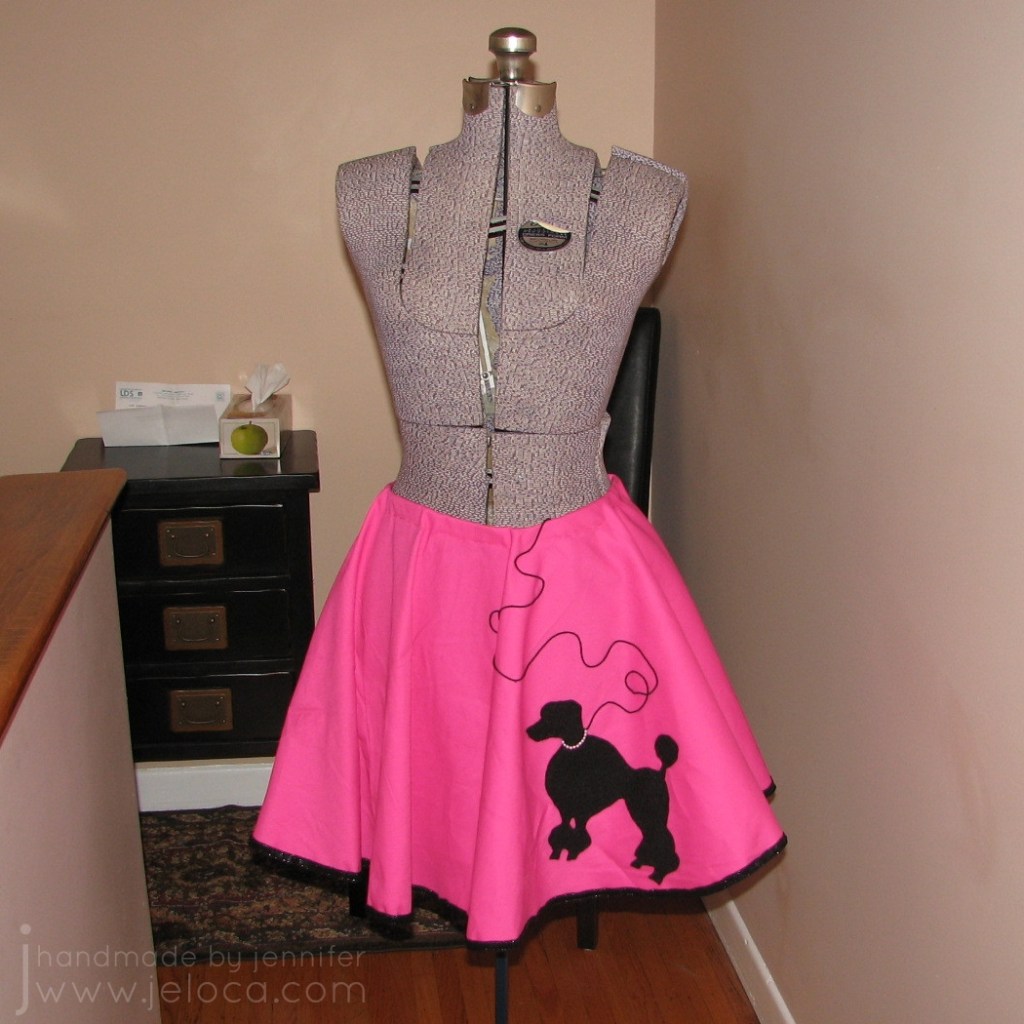
Et voila- the finished skirt. You can jazz it up with some music notes if you like, and can wear a crinoline underneath it too. For the complete look, wear your poodle skirt with the following:


-white t-shirt, preferably with a collar
-short white socks
-tennis sneakers
-black wide belt over the skirt and t-shirt
-ponytail (you can use some of the excess skirt fabric for a hair bow)
-light pink lipstick
-pale or no eyeshadow
option: tie a short scarf around your neck

Have fun rockin’ around the clock at your next sock hop!

This post may contain affiliate links. This means I might make a small commission on purchases made through the links, at no cost to you.


Leave a comment

The Vegas Scarf (AKA The Knitting Game)

Update: see end of post for information about a downloadable pattern pdf

A knitting game, you ask? Is such a thing possible?

“Yes!” I say.

This game evolved from a challenge I was given in my knitting class to knit a “random” scarf- we had to select a bunch of varying yarns in colors we liked and work them in knit and purl rows to form a scarf. It was to be an exercise in the textures you can achieve with those two little stitches.

Ahem. I can’t do “random”.  I needed to come up with a way to be random with as much control as possible…and the Knitting Game was born.

It’s so easy to play along! All you need is 6 balls of yarn, 1 die, 1 coin, and a long circular knitting needle that is a bit larger than the average thickness of your chosen yarns. I used a 9 US/5.5mm but if you are using mostly aran weight and thicker, you might want to choose something bigger.

On a piece of paper, assign each of the 6 skeins to a number 1 through 6.

Also assign the “heads” and “tails” of the coin to knit and purl (not necessarily in that order).

You also need to decide how long to make the scarf. I wanted mine about 6′ long including a 4″ fringe at each end, so I cast on enough sts to be about 5′ long.

Now the fun part!

Step 1: Roll the die to get a number.  Cast on with the yarn that matches that number.  Cut yarn, leaving a 4″ tail.

Step 2: Roll the die to get a number.  Toss the coin to get “heads” or “tails”, and depending on what you designated “heads” or “tails” to be, it tells you to knit or purl that row.

Follow the directions of fate across the row using the yarn that matched the number you rolled on the die.  Make sure to start with a 4″ tail left loose, and cut the yarn at the end of the row, leaving a 4″ tail.

The 4” of loose yarn at the beginning and end of the row will become your fringe.

Step 3: Repeat step 2 until the scarf reaches your desired width.

Step 4: Once the scarf is the width you would like, roll the die to get a number and bind off with the yarn matching the number you rolled.  Don’t forget to leave a 4″ tail when you cut the yarn.

Knot the yarn ends together in groups of 2-5 strands to secure, and trim if necessary.

Voila! A completely random scarf that fulfills any need for control while leaving things totally up to chance! The coolest part is that no two scarves will ever be alike! 😀

Update!

This pattern is on Ravelry here.

This pattern is provided free above, but if you’d prefer an easy-to-print PDF version, I have made it available here for a very small fee. The PDF includes the full instructions in an easy to read layout with full color images.

This pattern was also published in the 2006 Knitting Pattern-A-Day calendar and has been featured in an assortment of guild newsletters as well as been used to run knitting classes/workshops. Future newsletter/class/workshop permissions are granted provided the pattern copies are purchased through me and all credit is given to me as the creator/designer.

*Updated January 2020