7 Comments

Super Mario Bros Petey Piranha DIY

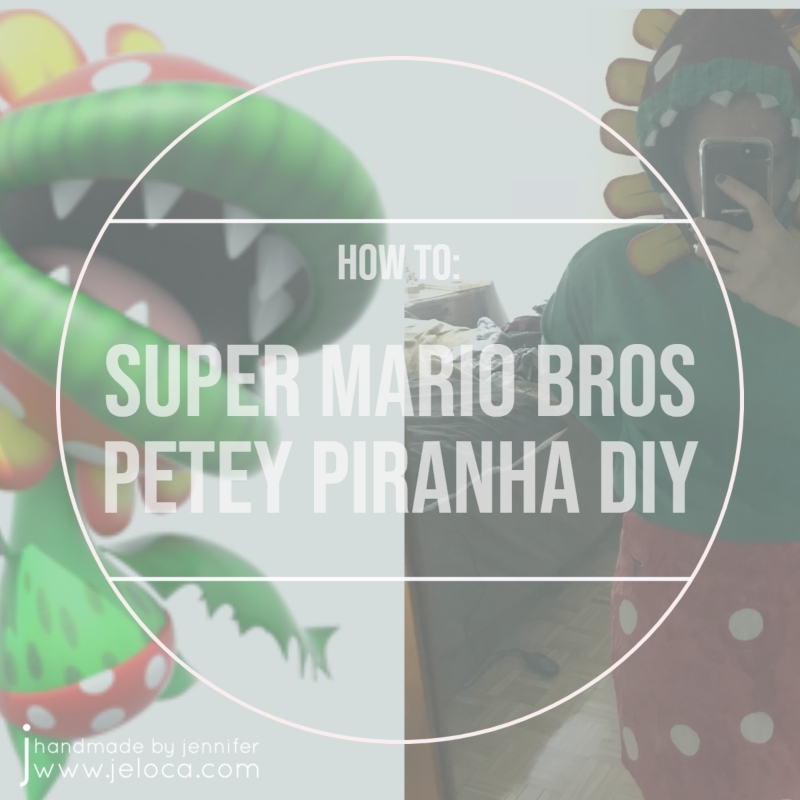
Mario Month 2023’s third DIY is a tutorial for a costume/cosplay for Petey Piranha,

This fabulous fellah is Petey Piranha. He made his debut in Super Mario Sunshine and is confirmed to be the leader of the Piranha Plants. While he’s not as common a Mario villain as Bowser or some of the others, our skit had eight dancers and needed a fourth “bad guy” to oppose our four “good guys”. I’ve already shown how we made the costumes and props for Mario, Luigi, Toad and Peach, as well as Wario and Waluigi. We already had a Bowser, and so Petey here made a great final baddie for our little cast.

I started this costume challenge with a visit to our local thrift shop where I was really lucky and found a solid green hoodie to be the basis of the top, as well as a white skirt as bottoms for our female Petey player.

The first thing I did was to mark off circles on the hood to be Petey’s…uh… face spots…? Mouth dots? I’m going to go with “face”. I used an appropriately-sized candle as a template and traced it out with a white colored pencil. It’s difficult to see in the first image (left side) but I also used a regular pencil to loosely mark off a border around the hood opening.

I used a measuring tape to loosely eyeball how high Petey’s yellow petals should be, based on the proportions of the character. I sketched half of the petal shape on a folded piece of scrap paper and trimmed it out until I had a nice, even petal shape of the right size for my hoodie.

The leftover yellow felt from my Wario costume DIY was perfect for Petey’s petals, and so I used my paper template to trace out 24 halves (to make a total of 12 petals)

I used sewing pins to tack two pieces together so they wouldn’t shift around and then with a regular needle and sewing thread I worked a tiny running stitch all around the sides and rounded top of the petal, leaving the flat bottom unsewn.

You can see in the image (below left) how the petal will look once it is turned inside out. Happy with the results, I continued until all 12 petals were stitched.

I turned them inside out and set them aside.

From there it was time to work on Petey’s face. I didn’t have any fabric paint so used regular acrylic paint for this DIY. I didn’t want the paint to bleed through the hoodie so I prepped it by stuffing it with a plastic bag, which in turn was stuffed with assorted packing materials. This also had the benefit of filling out the hood so I had a flat surface to work on. I also protected as much of the rest of the hoodie as I could by wrapping it in an additional plastic bag.

Using red paint I filled in the entire hood surface EXCEPT for those dots I’d traced earlier, and the lip area I’d marked off. The first image is the result after one coat. The second image was after a second coat of red and also after painting the face spots with white.

A cardboard box worked great as a support to hold the hood in a way that wouldn’t disturb the paint as it dried.
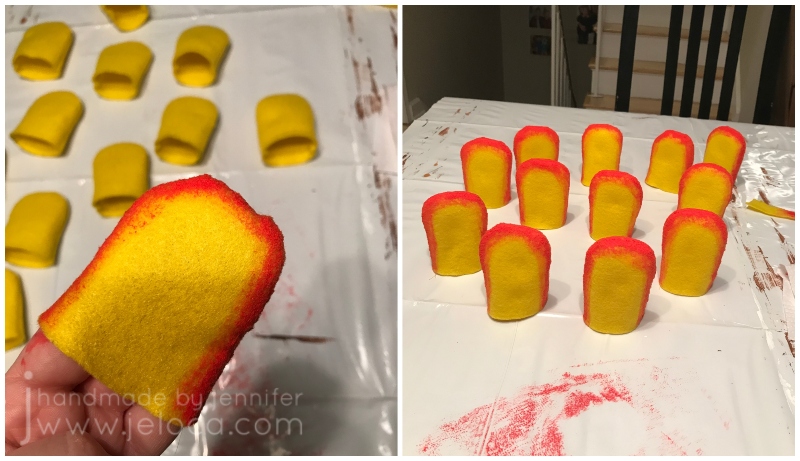
While I had the red paint out I drybrushed a bit around the edges of each petal. To drybrush simply dab off most of the paint onto a paper towel or other scrap surface before working on the felt. This will allow you to get the faded color around the inner edge and give the illusion of a blend.

Continuing to work with the red paint, I set to work on the skirt. After tracing out the spots with the same candle as for the face I painted the rest of the skirt, leaving the spots white. This would have been easier had I found a red skirt – I’d only have had to paint white spots. As it goes with thrift shops, however, you get what you get. (“…and you don’t get upset” as my kids’ daycare used to say!)
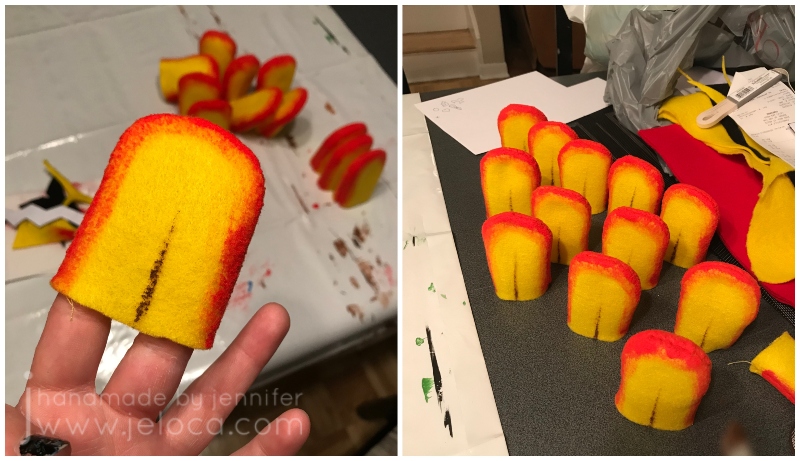
The final touch for the petals was to use a tiny bit of brown paint and a very thin, very dry paintbrush and give the centers their subtle center shading.

Before leaving things to dry I gave the skirt a second coat of red paint. I noticed the paint was bleeding into the white spot areas (as shown in the bottom center spot on the left) and so I went over each spot with white paint for a more crisp edge.

Once the paint had fully dried I was able to do the final touches. Petey has distinctive lip stripes, similar to those on a watermelon. Instead of doing detail shading with paint I went the easy route and drew stripes with an alcohol marker.
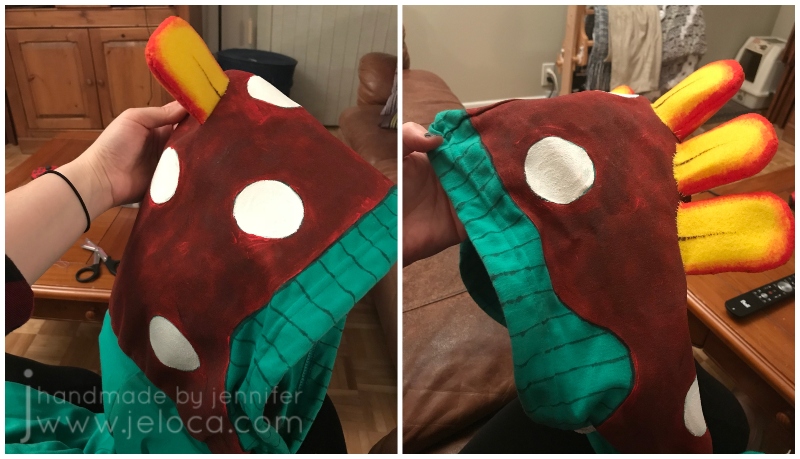
I used more of the yellow sewing thread to sew each petal into place around the hood. Instead of pressing the petals flat and sewing the one edge down I actually whipstitched the full oval of each petal opening down into the hoodie. This kept the petals open ensured they wouldn’t flop around on stage. Remember – just like all the other Mario-themed costumes and props, this outfit had to be durable enough to endure two weeks of quick-change performances, plus dress and tech rehearsals.

The final step to complete Petey’s face was to add his fangs. After figuring out a paper template to give me a rounded cone shape I traced a small paint bottle enough times for each fang and cut the pieces out from white felt scraps. Each circle was then cut into the flat shape that would fold into a cone.
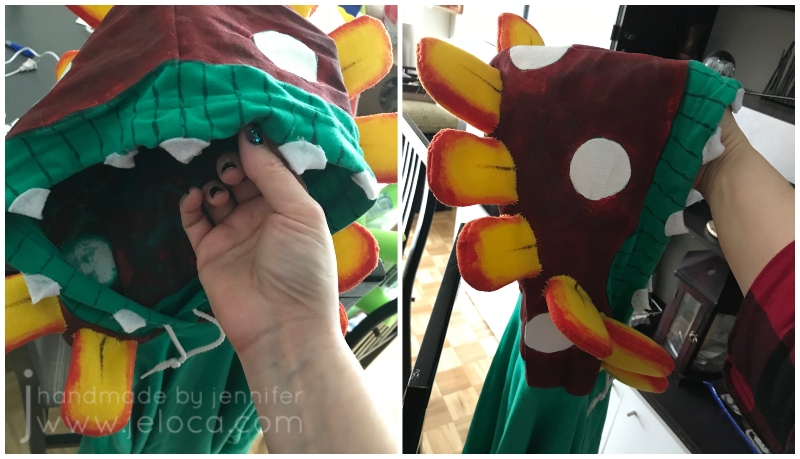
The cones were then sewn into place around the hood opening. Petey’s fangs are actually more inset into his lips but I wanted to be sure the fangs would be visible from the audience so moved them outwards a touch.

Here’s the final costume.

And here it is next to Petey himself. I wasn’t quite sure in the beginning how I’d pull this one off, but in the end he made a great villain in our little dance number and the costume held up throughout without any issues.
Other Mario-themed projects you might like:

This post may contain affiliate links. This means I might make a small commission on purchases made through the links, at no cost to you.


7 Comments

Super Mario Bros Toad Hat (Head) DIY

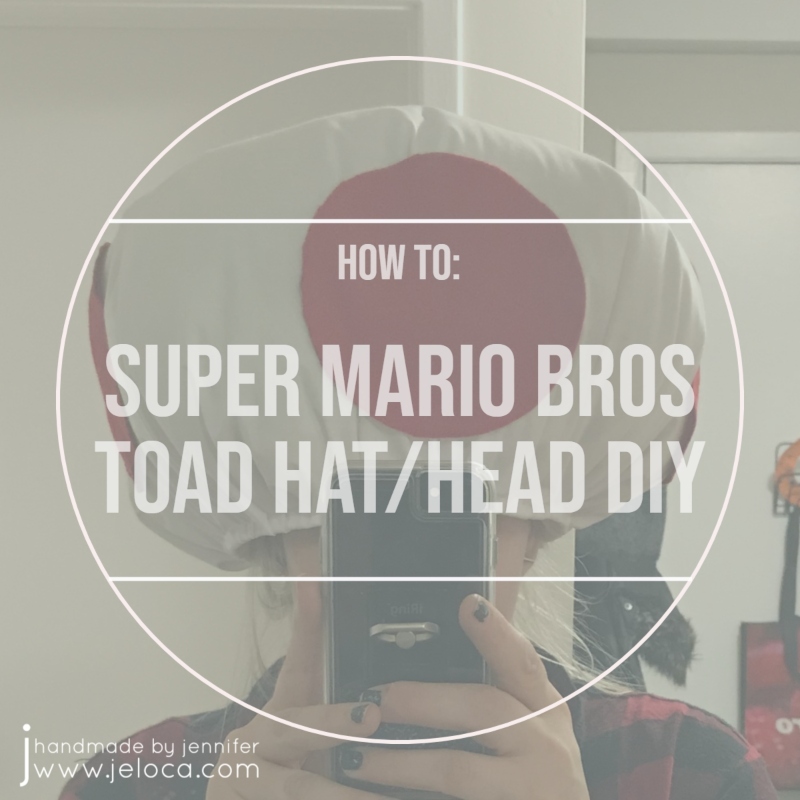
For my second post in this year’s Mario Month I’m going to demonstrate an easy DIY for Toad’s hat. I know – it’s been officially confirmed by Nintendo that it’s actually Toad’s HEAD and not a hat…but most people still refer to the white and red bulb as his hat so I’ll be calling it such in this post.

This is Toad:

A costume for a Toad is pretty simple as almost any colored vest, white pants and dark shoes will get the gist across. The main feature of all Toads and Toadettes is their big, pouffy toadstool-esque hat. Whether you call it a head or a hat there’s no doubt that it’s a needed part of any Toad cosplay and here’s how you can make your own!

What you will need:

NOTE: As with the rest of my Mario costumes & props this hat was needed for a stage show which meant it had to be durable enough to last for a number of rehearsals, dress rehearsals and then stage performances. As such while you can use cardboard to do these first few steps I chose to use plastic canvas for extra strength. The plastic might bend but it would be unlikely to tear or break making it more reliable for quick changes where the hat would get tossed around backstage.

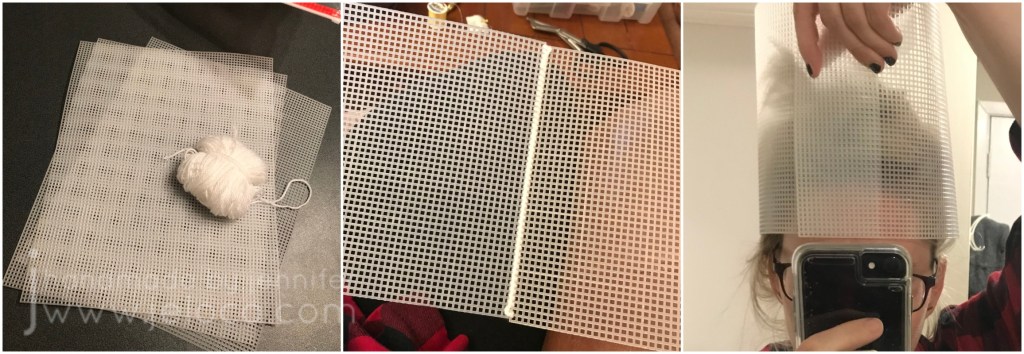
The hat needs structure to support its height so I started by aligning two sheets of plastic canvas vertically and whipstitching the side edges together. I repeated this with a third sheet and then tested the fit around my own head as the wearer would be another adult. I marked the appropriate row, cut away the excess and then whipstitched the final seam to create a tube.

I measured the diameter of the tube and traced out a circle of a matching size on a fourth sheet of plastic canvas, then cut it out. I could have whipstitched around the edge here as well but didn’t want to risk mis-aligning the pieces so for an easier option I used some of the white yarn to tie the disk to the tube in one spot with a knot. I then made another knot directly opposite the first so the disk was centered. I then knotted at the halfway point of each side so the quarters were each tied in place. This ensured the circle was evenly placed on top of the tube. Then I continued, knotting in pairs on opposite sides, until the disk was fully attached.

Try on the hat at this point. The tube will sink down so the disk rests on top of the wearer’s head. For the best result the lower edge should fall just above the wearer’s eyebrows, so if your tube is too long trim the bottom edge accordingly.

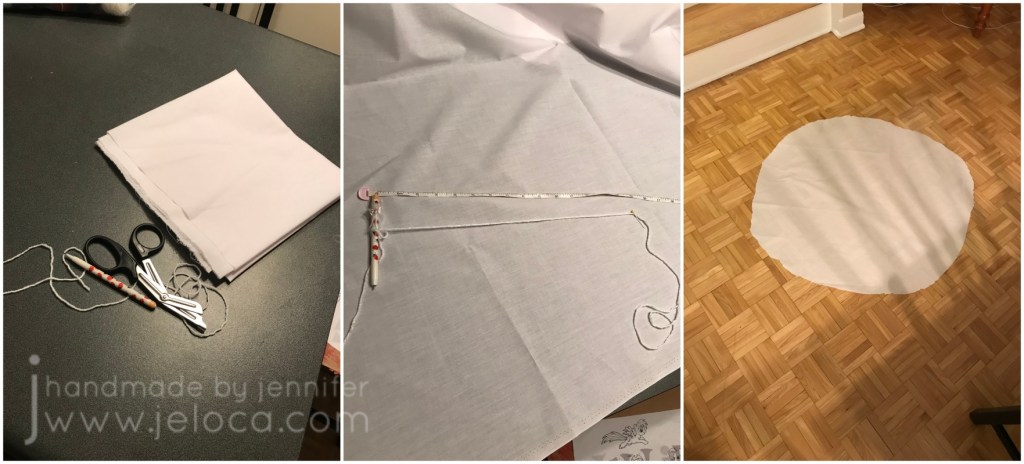
For the white outer shell of the hat measure the height up one side of your tube, across the top disk, and then down the other side. Add 2 inches for a generous seam allowance (1″ on either side). This will give you the diameter of the circle you will need to cut from your fabric. I didn’t trust myself to freehand an even circle so I divided this measurement by 2 to get the radius and tied a pencil and sewing pin the radius’ length apart on a length of yarn. I pinned the pin into the center of my fabric and swung the pencil around, keeping the yarn taut, to trace out the shape.

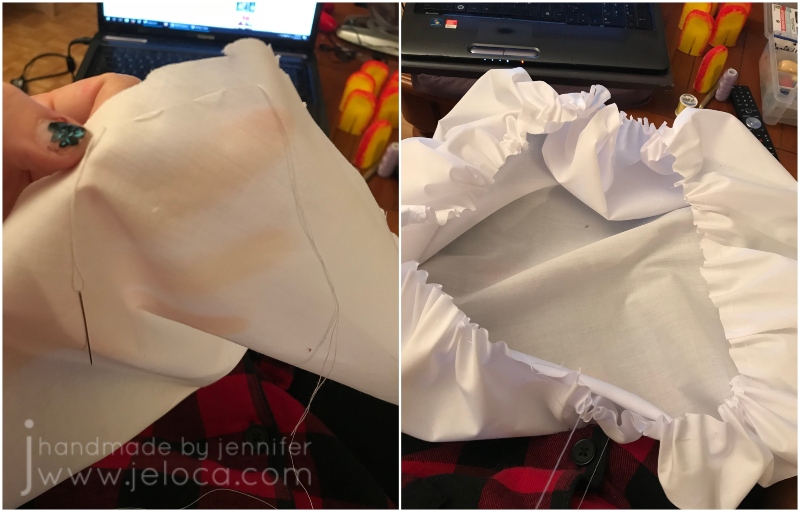
I cut a length of white sewing thread about 1.5 times as long as the outer perimeter of my circle and then sewed a running stitch all the way around, about 1/2″ in from the edge. When I got back to the beginning of the circle I snugged up the ends doing my best to keep the gathers even all around.

I inserted the plastic canvas tube into the bonnet-like white fabric and stuffed all around the sides. Don’t forget to stuff below the tube too so the top of the hat gets its round, puffy shape.

To join the fabric to the plastic canvas tube I switched to white yarn for strength and stitched around the open edge of the tube, through the white fabric. It’s a good idea to keep checking the look of the hat as you go, adjusting the gathers or adding more stuffing if necessary.

Here’s the finished puffy tube. I could probably have added more stuffing but I’d ran out.

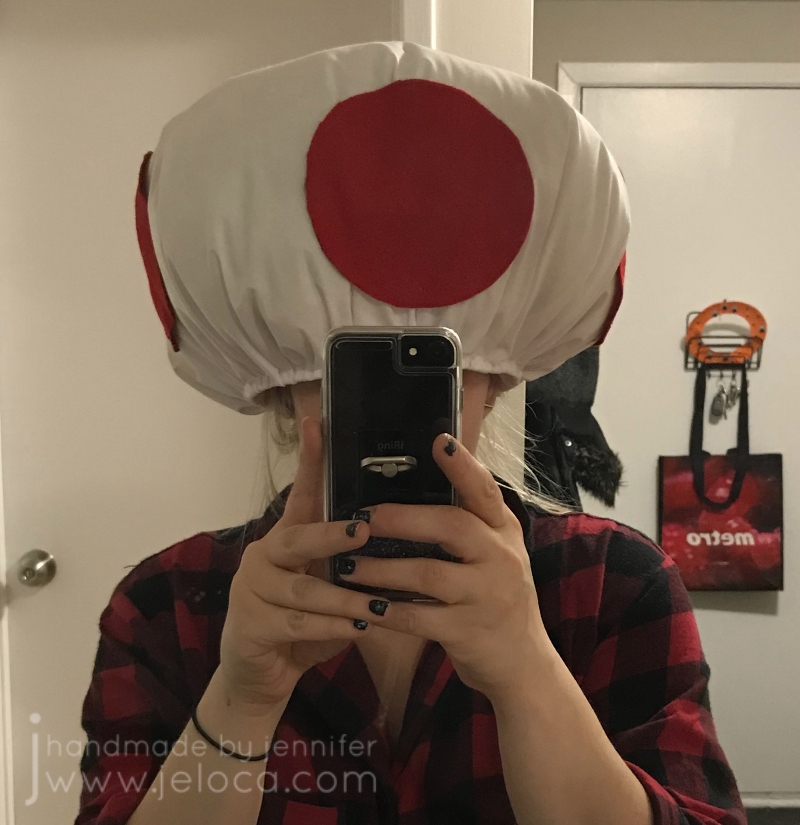
Toad’s hat has 5 colored spots. I found a bowl that was a good size for the appropriate scale and traced it out 5 times on some red felt. You can sew the spots in place if you like but I chose to hot glue them instead.

Voila! Your very own Toad hat/head.

The hat can be worn as-is or you can add a chin elastic if needed to secure it in place on the wearer.

It fit our Toad cast member perfectly and just like all the other props and costume parts, lasted through all rehearsals and performances without any signs of wear or damage.

Even through vigorous dance routines and quick changes between numbers!

Other Mario-themed projects you might like:

This post may contain affiliate links. This means I might make a small commission on purchases made through the links, at no cost to you.


7 Comments

Super Mario Bros Princess Peach Star Wand DIY
Can you believe it’s March already? It’s the 2nd annual Mario Month here on the blog and this year’s first post of the Super-Mario-themed collection is a DIY for a star wand you can carry as part of a Princess Peach costume.
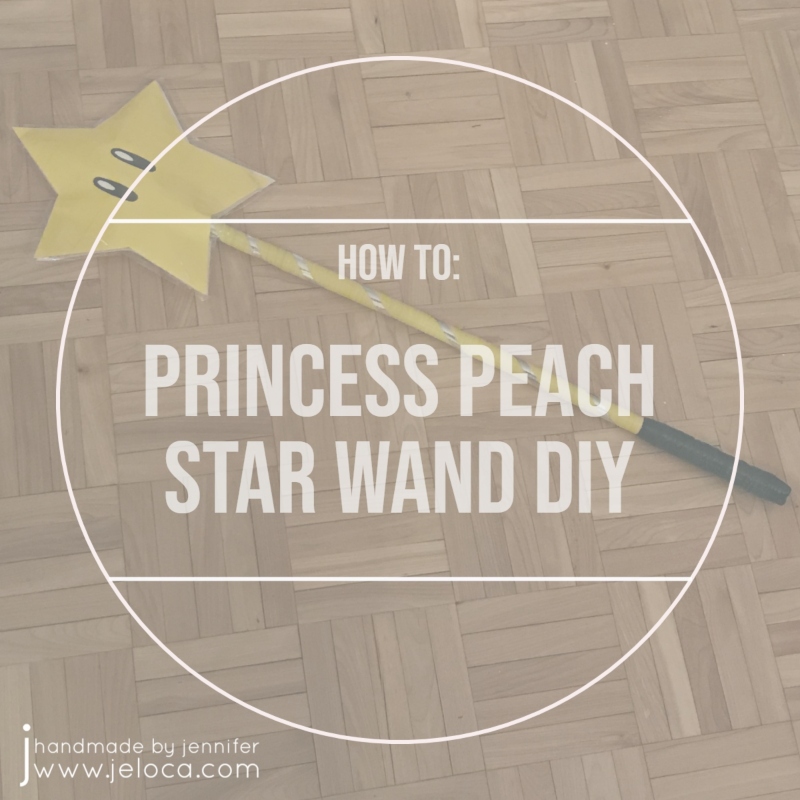
I’d been asked to make the accessories for a Mario Bros skit and was given the above example of the desired wand for our Princess Peach character. Easy-peasy! Most of the needed supplies can be found at the dollar store or you might even have them on hand already.

You’ll need:

Other supplies that I used for the plastic canvas insert step but are not necessary if you use heavy cardstock and/or don’t need your wand to last as long as we did:

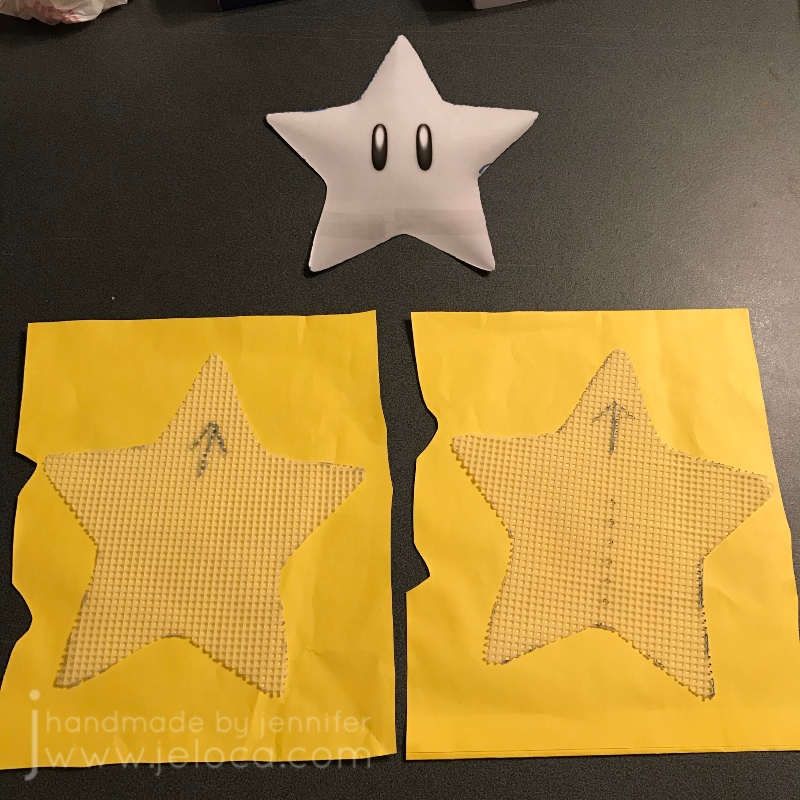
Start by scaling an image of the Starman to the proper size for your wand and cut it out of regular paper. (Alternatively you can draw a star shape freehand but I ALWAYS mess those up!). If using heavy cardstock for your star you can jump to the next step. My bag was the perfect color but a bit flimsy, and this prop had to last for at least 6 shows and a dozen or so rehearsals, so I chose to reinforce mine with plastic canvas inserts. If you would like to do the same trace your star template onto plastic canvas. It’s a good idea to mark which direction is “up” so your stars will be sure to align.

NOTE: I should have made my plastic canvas inserts SMALLER than the Starman template. As you’ll see below, I ended up trimming them down so the yellow stars could meet evenly at the edges. To avoid this mistake trace a second line about 1/4″ inside your original edge and cut out on that line.

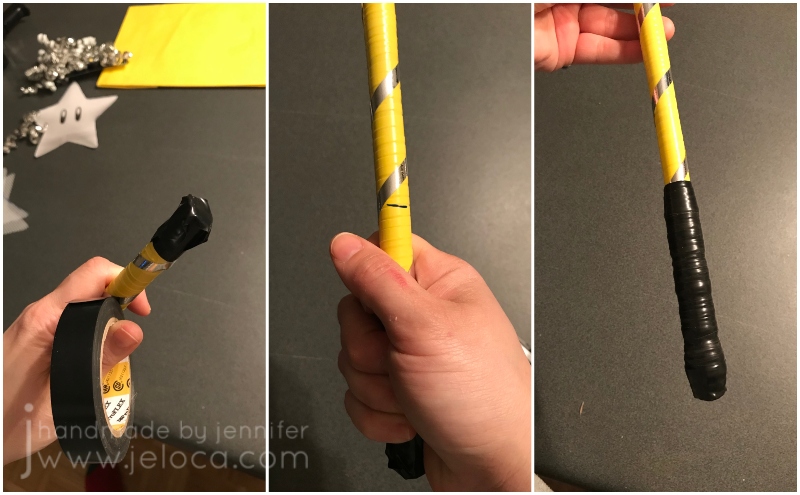
Wrap your dowel evenly with yellow electrical tape. You can paint the dowel yellow instead but for our purposes the electrical tape was more durable and waterproof. It also allowed me to even out areas where the bamboo was uneven by wrapping more (or less) in those spots. Then wrap again with the silver ribbon, spacing out the wraps to create diagonal stripes. You can secure the ends with regular scotch tape or more of the yellow electrical tape – neither end will be visible once the wand is complete so use whatever you’d like.

Cover the bottom end of the dowel with black tape. I used my fist as a rough guide for how long I wanted the handgrip to be and then wrapped more black tape, padding out the bottom edge slightly for a comfortable hold.

Optional: I debated hot-gluing the plastic canvas to the dowel but was worried it would break or separate during rehearsals (we were a rowdy bunch lol) so needed something permanent and secure. I decided to use the holes in the plastic canvas to my advantage and sew through the dowel to keep it in place. I marked holes on the dowel using the plastic canvas as a template for placement and then drilled directly through the bamboo dowel with my Dremel. I have a Dremel drill press which makes this step super easy but it’s 100% NOT necessary.

Now it’s time to trace your Starman template onto your yellow paper/cardstock.

I used carbon paper to trace onto both pieces at once to be sure both stars would be the identical size/shape, but this is totally optional. Just be sure to trace on the reverse side so in case you leave any pencil showing it will be on the inside of your finished star. I tested the plastic canvas inserts and realized I hadn’t left any clearance so had to trim down both of my stars to ensure the paper pieces would be able to touch. As mentioned above – if you do this be sure to cut your plastic stars smaller to start.

To attach the stars to the dowel I sandwiched them on either side of the bamboo and sewed a running stitch from one side to the other, then up to the next hole, and back to the first side…repeating this until I’d worked through all the holes. I was able to fit my yellow yarn but you can use doubled thread if your yarn is too thick. This will work best if you pre-mark your hole locations onto both pieces of plastic canvas first, to ensure you’ve sewn both stars to the same height and equally centered.

Use yarn to whipstitch the edges of the star closed.

I used the carbon paper again to trace Starman’s eyes and then colored them in with black Sharpie and a white POSCA paint marker.

Cut out both sides of your Starman. As one final layer of stage/rehearsal protection I sealed the paper’s surface with a layer of clear packing tape on both sides. This would ensure that the paper couldn’t accidentally rip or tear.

The final step is to sandwich the yellow star layers on either side of the plastic insert. Place the face side (with the eyes) in front of you and lay a few strips of packing tape evenly across, leaving a few inches of extra tape all around. Carefully pick up the taped piece and turn it over so the sticky side is facing up. Put the wand/plastic piece in place and then lay the back of the star down, yellow-side out, being very careful to line up both stars perfectly. Apply more strips of packing tape so the sticky sides meet and lock the stars together. **It’s a bit awkward to keep the back star aligned while laying the strips of tape which is why I do the face side first.

If not using a plastic insert then before placing the second side use extra packing tape to tape the dowel to the inside of the first side.

Press the tape together really well all along the edges of the star to really seal the front and back together, and then cut around the star leaving a thin strip of taped edge. It won’t show much (especially from the stage) but it guarantees you don’t trim too close to the paper and create a gap between the pieces.

Enjoy your star wand!

Ours worked great – lasting well through all rehearsals, tech week, and performances!

Other Mario-themed projects you might like:

This post may contain affiliate links. This means I might make a small commission on purchases made through the links, at no cost to you.